

Staff Report. Sorry fishermen, we built too close to the shoreline and now need to “renourish” the beach.
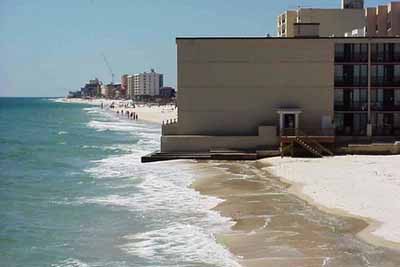
Recent Gulf of Mexico – hotel chain stupidity.
[dropcap]I[/dropcap]n 2005, Florida got pounded with four hurricanes and they spawned “. . . beach re-nourishment projects that may really be acts of marine genocide,” wrote Terry Gibson in the Florida Sportsman that year.
He went on to add: “Four hurricanes don’t hold a candle to the potential fish habitat disaster funded in the name of ‘shoreline protection.’
In the wake of last season’s storms (2005), a panic-driven number of shoreline-armoring projects and so-called beach nourishment projects are proceeding throughout the state. Bulldozers are burying famous pompano beaches of Martin County. The wonderful snorkeling reef at Phipps Park in Palm Beach County is doomed. Dredges are on the way to Sanibel and Captiva islands’ legendary snook beaches, among many others. Meanwhile, marine scientists, environmental groups, veteran anglers, the dive community, the surfing community, and tax-dollar watchdogs such as Taxpayers for Common Sense say that much of the coastal armoring and sand dredging needs to be curtailed, if a goal is to protect biological diversity and abundance as well as outdoor recreation along Florida’s coasts. . . .”
The one-percenters, mega hotel chains, resorts and developers, with the help of dumb and dumber politicians, have been mindlessly building up tight against shorelines for decades. Shorelines that for thousands of years naturally migrated – alternately landward and seaward. Man-made shoreline protection used to be considered a local project. A single landowner or community designed a site-specific defense against erosion. While this effort might solve their erosion situation, the problem with this approach is that it often results in erosion on adjacent or nearby stretches of coast. Then the adjacent or nearby communities must also take defensive action. Finally, even the science deniers are beginning to grasp the concept that the shoreline environment is a system in its entirety, with many processes at work within it. If you make changes to any part of the system, a natural response, however unexpected, is likely to occur. More than 70% of Earth’s shorelines are retreating due to rising sea levels. As shorelines move landward, structures located on or near the beach may be destroyed. In addition, communities may lose significant amounts of income if they lose the use of their beaches. It is, in fact, the interaction of the natural migration of the beach with the placement of beachfront structures that creates the demand for shoreline protection.
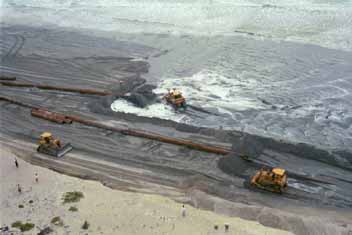
If no homes, roads or businesses were built in the coastal area, beach retreat might be seen more as the fundamental process that it is and not as a threat that should be thwarted. Beach nourishment is much more than dumping additional sand onto the beach. Mathematical models, although controversial, have been developed to determine how much sand is needed and its most beneficial placement. They also forecast how long until the next round of nourishment is required.
A nourished beach erodes faster than the original beach.
A shoreline renourished will completely eliminate that beach as a place to fish. If you enjoy fishing the shore and renourishment comes to your beach, you can forget that fishery for decades and if it’s renourished again – you’d best move away because the water will be dirty for years and nothing will be alive for miles out to sea. The food chain web will have been annihilated in the first round.
