
Angie’s brown. Envato.
Here’s how. Let me explain
By Henry Clement
A fly rod longer than 9-feet but shorter than 10-feet is, by original definition, a switch rod—a term first designated by R.B. Meiser in 1979 or 1980. Over time, these rods have gained various labels, such as micro Spey rods, but none more accurately describes them than “switch rods.” Their defining feature is the ability to be cast both conventionally (overhand) and Spey-style, provided they have a secondary grip below the reel seat, often called a fighting grip.
NOTE:
The term “switch” rod did not originate from the rods’ improved casting versatility. Instead, the name came about as an offhanded remark by a friend of R. B. Meiser, who was experimenting with various fly rod constructions with others.
Only a decade ago, most high-end fly rods were heavier than today’s models. Advances in materials and design have made rods lighter, unlocking new performance possibilities. Innovative rod makers, like Sage, Orvis, and others, recognized that lengthening these lightweight rods by just a few inches could significantly increase their versatility and fly fishing effectiveness. These trending switch rods are in the realm of over $1,100.
My fixed income has lost buying power even faster than the price of chuck roast has risen
With new fly rods costing over $1,000 and beyond my financial reach, I needed to adapt my 9-foot 4-, 6-, and 8-weight rods to function as switch rods—or consider investing in Orvis’ Recon saltwater series.
I was tired of wearing out my hand trying to Spey cast by gripping the end of the reel seat for a touch-and-go cast. The extra casting length and improved accuracy from using the reel seat as a switch grip enabled longer, easier casts and reduced the risk of snagging foliage behind me.
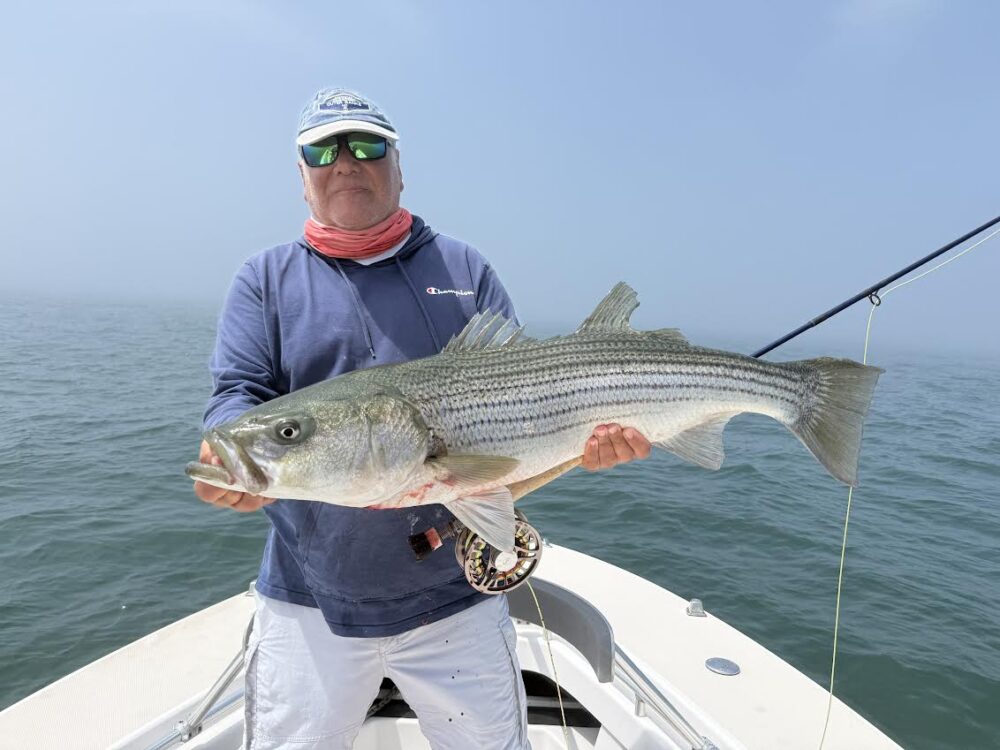
Two days ago. “The Dentist” captures a big one. Photo by Captain Andrew Derr. Some open days–contact…
The reality, though, is that my hand slipped off the cast often
Wet makes for slippery surfaces, and all day half-assing hurt my fingers as I tried to hard-pinch the end of the metal reel seat.
High-end rods from Sage, Orvis, and others trend toward traditional switch rods—over 9 feet and under 10 feet long—but all cost a lot of money–out of my price range. My alternative 1: add a fighting butt to my existing rods. But not being handy with tools, I turned to an expert, Kenny at Mud Hole (see link below).
It turns out, adding a fighting butt to conventional fly rods has been part of rod building since time immemorial. The true switch rod, invented by R.B. Meiser in the late 1970s, brought a magic ingredient. The ability to make short casts with little effort, long casts beyond belief, and perform any overhand or Spey cast with less effort than any 9-foot or over 10-foot fly rod ever could. The exception there being in the hands of a professional guide or a uniquely skilled angler.
While not universally ideal
Switch rods can be unwieldy in tight spaces [tenkara makes life so much more enjoyable], or on skiffs, but they can be Spey-cast with much less effort than traditional 10-foot-or-longer Spey rods, swing flies with longer exposure, and are good nymphing rods as well.
So, is adding two inches to my 9-foot fly rod with a fighting grip worth voiding the warranty on my $700 rod?
Let’s count the ways this upgrade can improve your angling, and what drawbacks it brings.
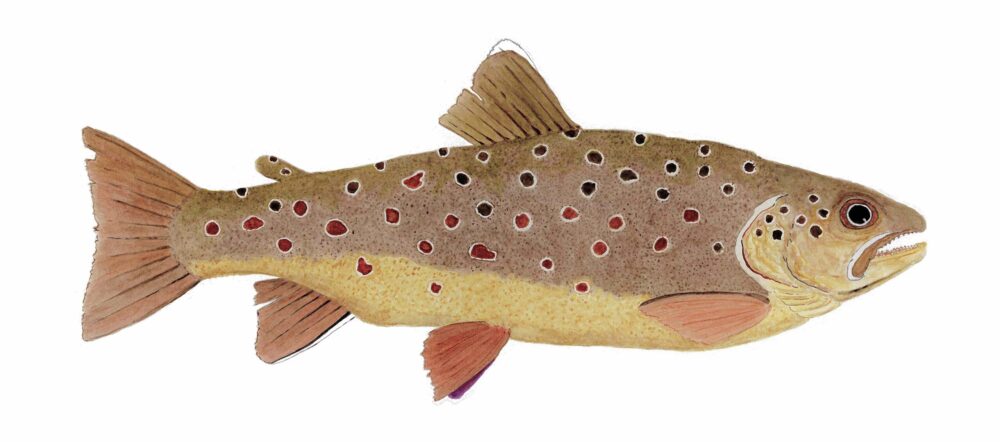
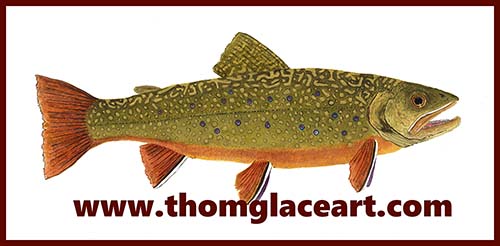
Gillaroo Trout found in Lough [lake] Melvin, Ireland. Illustration by award-winning artist Thom Glace.
Pros:
– Use your offhand as a guide on the extended butt for more accurate casting.
– Spey casts, roll casts, and touch-and-go casts become much easier by leveraging with the fighting butt.
– Better mending and drift control—even slightly longer rods keep more line off the water, so drag is easier to manage and flies drift more naturally.
– More reach—an extra foot helps you fish farther across current seams, over structure, or from a boat without wading too deep.
– Stronger leverage—a longer rod gives you more authority in hook sets and fighting fish, which is useful when turning fish away from cover.
– Maintain versatility—handle dry flies, indicators, tight-line nymphing, and small or large streamers well.
Cons:
– Loss of warranty.
– Loss of storage tube—at 9’2”, the rod may no longer fit.
– Conversion cost: possibly over $75 [if shipping is an issue] per rod if you aren’t handy with tools.
– You’ll be without your rods during the conversion process.
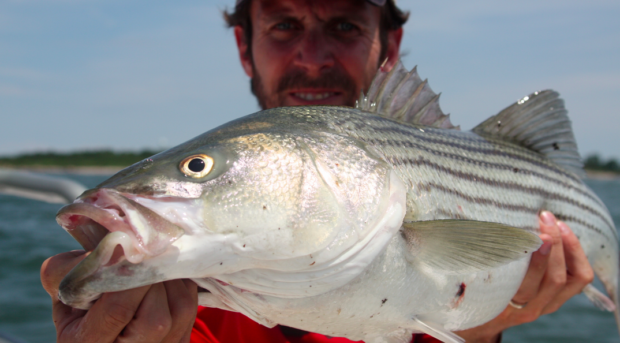
Feature Image: Captain Andrew Derr with a spring run striper. Photo credit Capt. Derr
IF! Alternative A: Everything you need by a reliable resource
If you value a solid warranty and are in the market for one or more 9-foot fly rods with an ideal fighting grip, look no further than Orvis’ saltwater Recon rods. These are remarkable casting machines, reasonably priced at $698. A demo cast revealed a familiar feel reminiscent of the superior-ranking Helios F series. Personally, my goal is to own the 6-, 8-, and 10-weight models. From trout to salmon and striper to tarpon, these rods cover nearly every casting scenario with impressive accuracy and near-limitless distance. Whether you prefer dry-fly angling, wet flies, nymphing, drifting, or mending on the swing, this series—from 6- through 11-weight—offers almost everything an angler could want in one lineup.
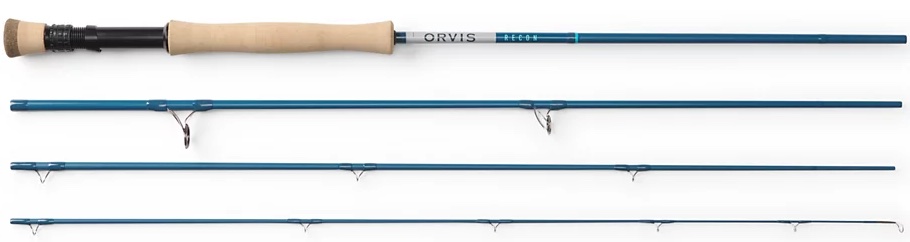
Alternative B: Here is who to contact if you want to add a fighting butt to your fly rods:
Mud Hole Custom Tackle (the leading supplier for rod building and tackle crafting) can be reached at their Oviedo, Florida headquarters.
- Phone: 1-(866)-790-7637 (Toll Free) or (407)-447-7637 (Local)- ask for Kenny
- Email: support@mudhole.com
- Hours: Monday–Friday, 9:00 AM to 6:00 PM; Saturday, 10:00 AM to 3:00 PM (EST)
- Address: 2133 Component Loop, Suite 1001, Oviedo, FL 32765
- Fighting butts…
Mud Hole offers several learning paths depending on your experience and schedule:
Watch video: How to add a fighting butt
Sponsored