
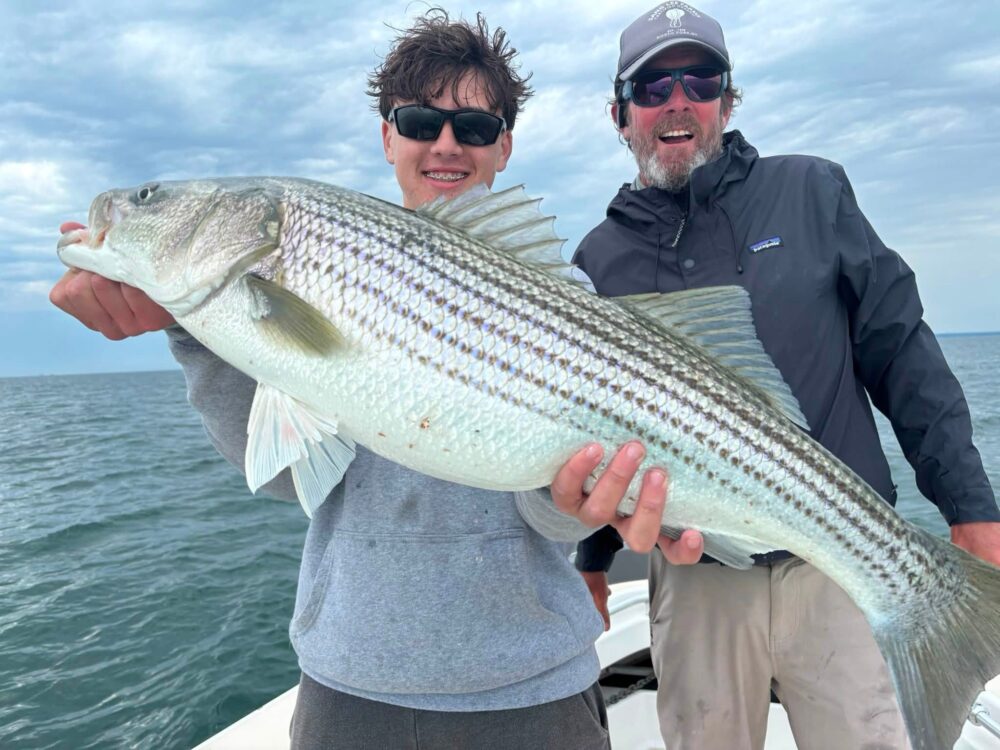
Just a week ago, Capt. Andrew Derr introduced a young angler to striper-ville on Long Island’s North Fork in New York.
While the following review is commendable, it overlooks several important aspects.

Henry Clement, Rehoboth Beach, Delaware, August 2023. Photo by Captain Andrew Derr.
By Henry Clement
Hatch Magazine reviewed Orvis’ redesigned Recon fly rods, rating them as very good. The review notes that these rods are heavier and lack the crisp casting or refined finish of the Helios F and D models, placing them in a middle ground.
Hatch’s assessment is accurate, but it is important to consider the broader context of these rods’ real-world performance and versatility
Another view, from Captain Andrew Derr of Greenport, Long Island, New York—who also spent years guiding in the Florida Keys– would likely agree. Derr, however, is known for his practical approach to client needs, much like myself, perhaps as an octogenarian author.
In real time
Onboard, Derr selects rods based on his clients’ skill levels. A quality glass rod, paired with the right fly line, can offer superior feel for both experienced anglers and beginners, often resulting in more enjoyable and effective casting compared to the more demanding Helios or Recon rods.
But
However, the Recon series deserves more recognition for its performance, especially for intermediate and experienced casters. The duality of these rods stands out. The redesigned Recon saltwater models now feature extended handles below the reel seat, available in 6-weight through 11-weight options. This design provides excellent value and makes the rods ideal for dynamic touch-and-go or roll (spey) casts. Notably, while extended handles are becoming more common across the industry, most manufacturers offer this feature in only a limited selection, sometimes as light as a 7-weight. These are clearly designed for small saltwater game fish.
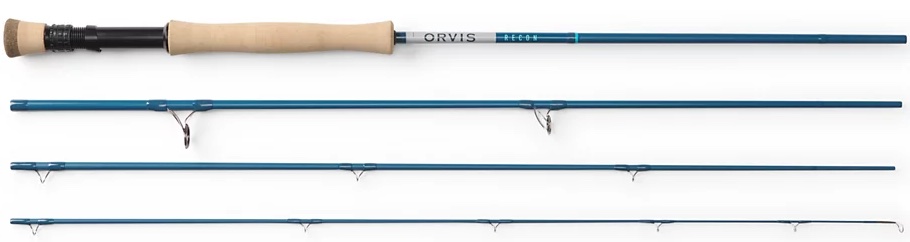
Orvis Recon–
In addition, according to Brian Flechsig of Mad River Outfitters
Attaching a fighting butt creates a longer lever and additional contact points with your arm, Flechsig explains. When used properly, a fighting butt can dramatically improve precision. It also provides better leverage and increased comfort when battling large fish or casting heavier lines and bigger flies. —paraphrased from this video …
Game fish tasked
For larger species—such as Alaska or Patagonian trout—anglers typically prefer nothing less than a 6-weight, and for Keys or Bahamas bonefish, at least a 7-weight with a fighting butt (extended handle) is standard. For lighter fishing, such as using a 4-weight for crappie, managing spey-like casts often requires fingering at the base of the reel seat to improve roll casting and avoid shoreline obstacles. Watch this YouTube video by Sameo.
Spending
Though priced in the mid-range, the Recon fly rods deliver performance that exceeds expectations for their class, rivaling higher-end models in casting ability and, most assuredly, versatility.
At $698, the Recon saltwater models represent an undeniable value for anglers seeking a new rod. They are a serious contender worth trying at your favorite fly shop before making a purchase. While the following review is commendable, it overlooks several important aspects.
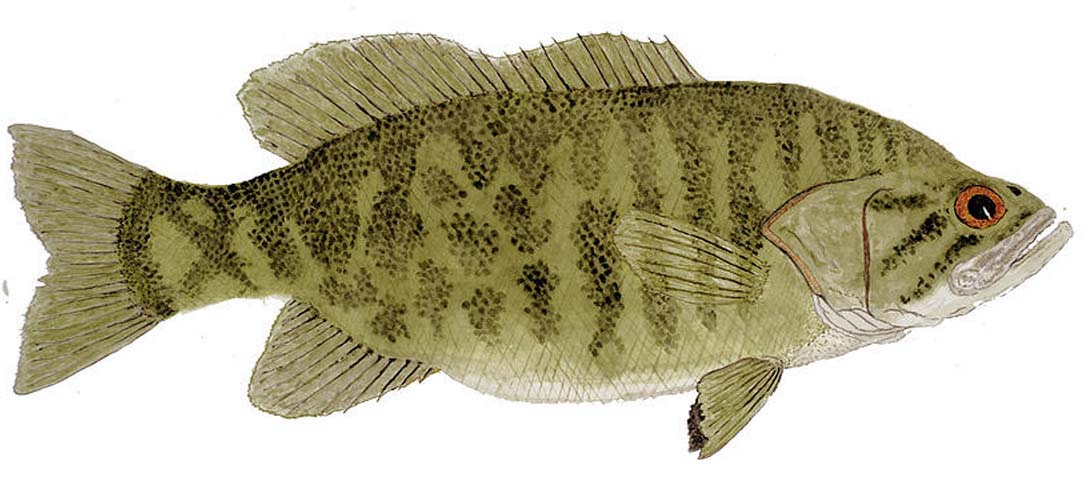
Smallmouth bass illustration provided by Thom Glace, award-winning watercolorist, conservationist, and fly fisher. Visit his website here . . .
Sponsored