
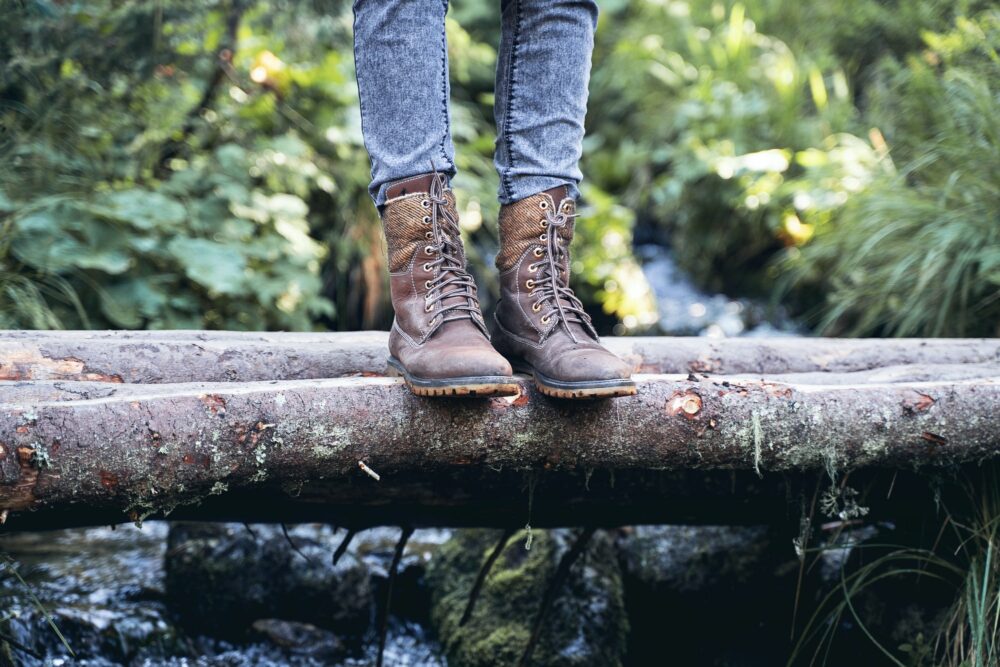
I prefer anonymity. Cool boots…
Lobbing flies and calling it casting?
NOTE: The article is abridged:
Since then, Vladi’s nymphing method has been imitated and renamed across Europe and the world. Over time, it’s been adapted by anglers of many nationalities, but the fundamentals remain.”
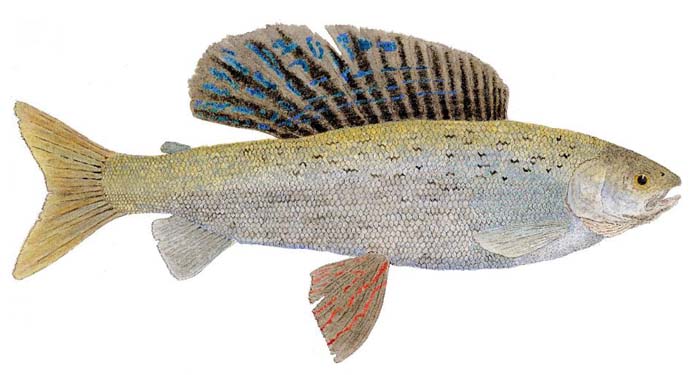
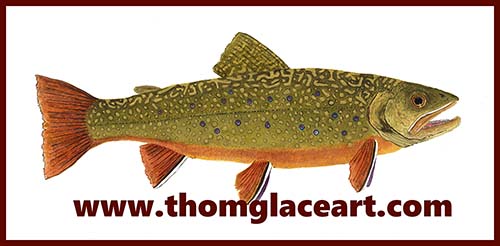
“A Study of an Arctic Grayling with Montana Local Markings”—created from photographs provided by the Grizzly Hackle Fly Shop staff in Missoula, Montana—was donated to Casting for Recovery in 2016 by Thom Glace to help raise funds at the Montana Auction. – Thom Glace
Polish Nymphing Facts [according to Twarog]:
- The Polish method works best in fast water, about three feet deep or no higher than mid-thigh. Tail-outs of pools or just downstream from riffles are prime feeding spots, even if the water is a bit off-color.
- Use at least a 9-foot, 4- or 5-weight rod. I use an Orvis Recon 10-foot 4-weight. Your leader should be a little more than two-thirds the length of your rod (for a 9-foot rod, use a 7-foot leader; for a 10-foot rod, I use an 8-foot tippet as leader).
- If you want to switch to dry flies, keep the same floating line but swap your tapered leader for a straight tippet—it will sink much faster, and you’re good to go.
- You’re not casting the nymphs; you’re lobbing them upstream. No indicators, sighters, yarn, or colored line are necessary. This is an active, not passive, way to fish: you’re triggering a strike, not standing around watching a bobber.
- Use a single weighted fly or a multi-fly rig. With a multi-fly rig, one fly (the anchor) must be heavy enough to get the flies to the river bottom quickly. Flies are not arranged in tandem.
In a nutshell:
When fishing, hold your rod parallel to the water’s surface and pull the flies through the current. After you lob the fly upstream and feel it touch bottom, start pulling it downstream a little faster than the current. That’s the key.As you pull the fly downstream, keep the rod parallel to the water. When the fly is even with you, raise the rod slightly and let the fly drift a few feet downstream and rise toward the surface. Before you pick up your line to lob again, set the hook as if a fish is there—you’ll be surprised how many hook-ups you get. Trout and grayling often follow fast-moving food and will strike as it rises.If you don’t get a strike after two or three lobs, sidestep three or four feet downstream and repeat. Fish use their lateral line and vision to detect motion—this is why Vladi’s method is so effective.
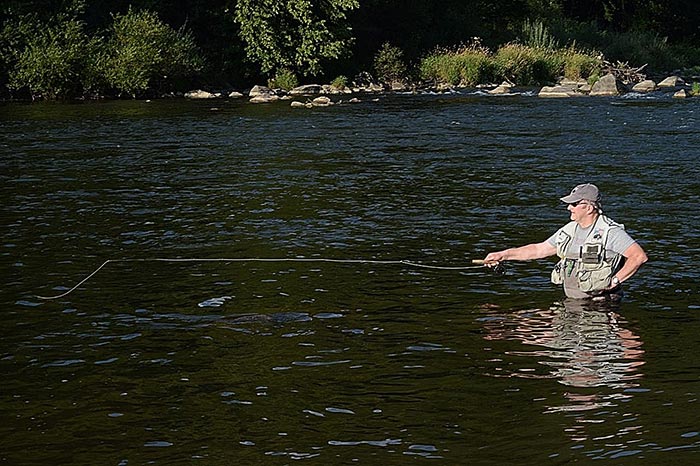
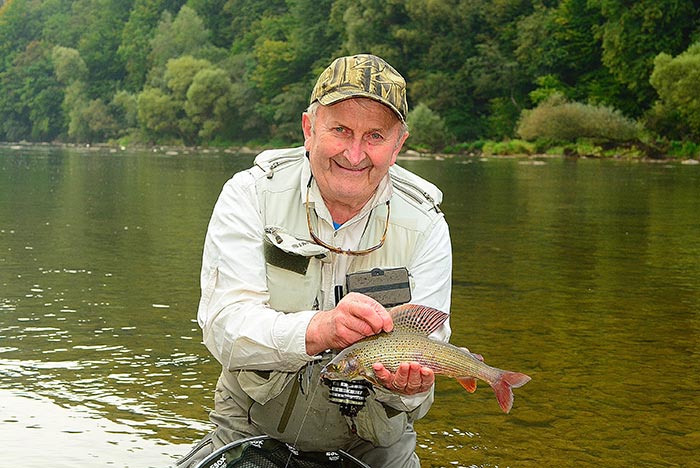
Wladyslaw “Vladi” Trzebunia—legendary Polish angler, pioneer of modern nymphing, and individual and team gold medalist at the 1989 World Fly Fishing Championships in Kuusamo, Finland—passed away recently at the age of 80. He is remembered as the father of European nymphing, and his legacy continues to inspire anglers worldwide. (Photo credits: Richard R. Twarog)
I do not use an indicator or multiple dangling hooks
I keep it simple to get the most out of being on the water. Thinking as Vlad does: lob the fly upstream and feel it touch bottom, start pulling it downstream a little faster than the current, and set the hook at the terminal of my drift even if feeling no pull. Shockingly, I catch a lot of trout practicing that seemingly foolish ploy.
NOTE 2:
Sponsored