
Title: Ferox Trout Scotland. Illustration by Thom Glace.


Henry Clement, Rehoboth Beach, Delaware, August 2023.
A European ghillie possesses specific knowledge of their river or lake beat. Referring to their Ferox or Gillaroo as trutta is unlikely
By Henry Clement
Ghillies often also have supporting roles in environmental maintenance, but their angling aptitude is what separates them from drive-the-boat guides. They know where fish lie at different water levels, what techniques work best, and the flies that catch.
It’s a brown trout, as in singular trutta
Ferox trout (Salmo trutta) show notable size differences compared to the brown trout that most anglers are familiar with. This is similar to how steelhead trout differ from regular rainbow trout; both types belong to the same species, Oncorhynchus mykiss. The main distinction is that steelhead trout are classified as anadromous, which means they migrate from freshwater to the ocean and back, while their non-migratory counterparts remain bound to rivers. The so called Ferox trout is a deep water lake trout, not a riverine brown trout, but both still a brown trout.
NOTE: While Wikipedia lists the ferox trout as Salmo ferox, the International Game Fish Association’s “World Record Fishes” 2024 only recognizes Salmo trutta (brown trout). No reputable scientific organization has classified the ferox trout, Gillaroo trout, or other similar European trout weighing around 30 pounds as anything other than brown trout, which is scientifically referred to as Salmo trutta.
Maturing
A Ferox is a brown trout that matures sexually later and has a significantly longer lifespan compared to the typical brown trout familiar to most anglers in the US and Canada. These impressive fish can occasionally exceed 3-feet in length and may live for over 20 years. While angler statisticians often consider 40-pounds to be the maximum weight for ferox-like brown trout, they certainly have the potential to grow even larger.
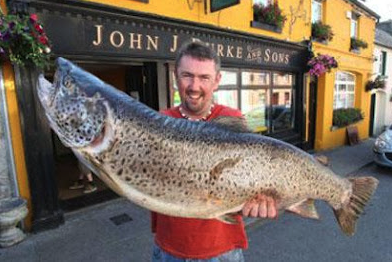
The caption under Mr. Jones’ photo reads: “Ceri Jones’ 23lbs-12oz trout ferox brown big fishes huge world record ever caught records largest IGFA gigante pesce biggest fish lake ocean sea giant freshwater saltwater fisch images.” No such record exists. Pour me another Guinness, lad.
A Piscivorous Growth Pattern
Ferox like trout exhibit rapid growth when they switch to a diet that consists primarily of fish, reaching lengths of about 12-inches, which is significantly larger than ordinary brown trout. The record catch in the UK is 31-pounds and 12-ounces, while in Sweden, an incorrectly reported weight is 37-pounds and 6-ounces. Additionally, there are accounts from Scotland of a ferox-like brown trout that weighed 39-pounds being caught years ago.
Throughout their lives, brown trout mainly feed on invertebrates, although larger specimens often adopt a piscivorous diet as they reach adulthood. This shift in diet not only accelerates their growth but also positions them as apex predators in the large, deep lakes they inhabit.
Physiological Differences
Ferox brown trout display distinct physical characteristics when compared to regular brown trout. They have deeper bodies and larger upper jaw bones that extend beyond their eyes, as well as fewer but larger spots. Their coloration varies from brown to silvery, featuring small dark spots. All brown trout, whether ferox-like or not, share spawning areas and create nests (known as redds) in the gravel of riverbeds. The ferox-like brown trout prefer deeper, colder lake habitats but remain isolated from regular brown trout, even when they inhabit the same lakes.
Spawning
Brown trout from deep lakes spawn during the same period as their riverine counterparts, primarily between October and December, with a peak in November. The timing of spawning is influenced by water temperatures, which reflect their close biological relationship with “regular” brown trout.
The brown ferox-like brown trout is facing endangerment, as it is found only in the cold waters of Scotland and Ireland, while a similar ferox-like trout exists in Sweden. In Sweden and throughout the Urals region of Russia, piscivorous brown trout can weigh up to 40 pounds, but they are not classified as “ferox trout.” throughout the Urals of Russia, piscivorous brown trout weighing up to 40-pounds exist, but don’t hold the distinct classification of “ferox trout.”

Salmo trutta illustration by award-winning watercolorist Thom Glace. Used with permission.
Angler Joy
While no explicit studies confirm that jumping constitutes a frequent behavior for the ferox version of brown trout, it’s reasonable to assume, similar to other trout species, that ferox trout can leap—especially when hooked. Many Scottish and Irish lake fishermen share anecdotal stories describing the ferox’s remarkable leaping abilities.
NOTE: In the IGFA World Record Game Fishes publication 2024, brown trout in the mega size of 39 + or -pounds on a fly and in excess of 40-pounds on conventional tackle–liberally scattered from the Great Lakes to Argentina, and Europe.
Sources:
Wikipedia, Inland Fisheries Ireland, angler forums UK, angler interviews, Swedish National Board of Fisheries, UK Fisheries Ltd, Steve Hudson, The International Game Fish Association ”World Record Game Fishes”, Steve Hudson
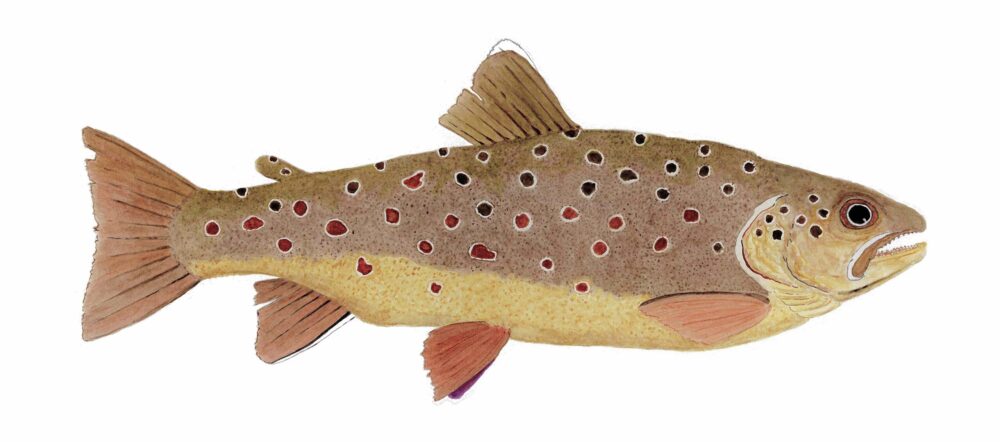
The Gillaroo trout is found exclusively in Lough Melvin, Ireland. This unique species, illustrated by award-winning artist Thom Glace, is a type of Salmo trutta. Local anglers have no chance of confusing the Gillaroo with a brown trout, as it is distinct from other variants like the Ferox. In fact, it can be difficult for anyone to recognize that both the Gillaroo and Ferox are classified as Salmo trutta, or brown trout.
In this video, take notice of the males hanging around in the background waiting to do their part
Sponsored