

Don’t get wrapped up in the vanity of your own opinions. — Shakespeare

Henry Clement, Rehoboth Beach, Delaware, August 2023. Photo by Captain Andrew Derr.
By Henry Clement
A conventional caddis-nymph fly tied on a #16 hook is limited by the design of that hook. The shank determines body length; the bend and gap influence the fly’s profile; and the hook itself remains part of what the trout sees. If the imitation needs to be a size #16, then the entire package—including its hook—is usually size #16.
A tube fly liberates the tyer from that limitation
The fly can retain the length, bulk, color, segmentation, and overall silhouette of a #16 caddis larva or pupa while being rigged with a smaller trailing hook—perhaps a #18 or #20 depending on the tubing, materials, target species, and fishing conditions. The fly is not size #18 or #20 solely because its hook is smaller. Its imitation size remains #16.
Only the hook has been shrunk
That distinction should be clear, yet objections to tube flies often stem from confusing the two. Someone might say that a #16-sized nymph carrying a #18 hook is “too small to hook a trout.” But trout regularly eat entire caddis imitations tied on #18 and #20 hooks. A fish that can take—and be landed on—a full #20 fly is not suddenly beyond reach just because a larger imitation body sits ahead of it.
The key question is not whether the hook’s size matches the fly’s nominal size. It is whether the hook is properly selected and positioned. It must have enough gap to clear the tube and any dressing, adequate wire strength for the fish and water conditions, and a point placement that reliably holds. A very small hook buried in a thick-bodied tube fly may be a poor choice. But a slim caddis imitation tied on appropriately narrow tubing and paired with a proportionate hook presents no logical issue.
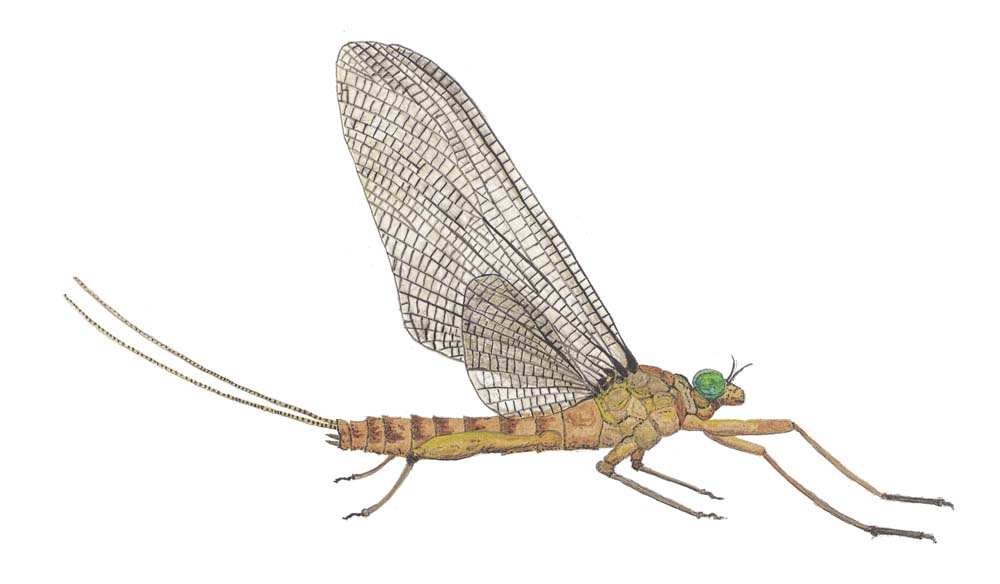
Male March Brown Dun Mayfly – Thom Glace
Why a Smaller Hook May Help
A smaller hook can reduce the amount of metal and visual clutter associated with the imitation. In clear, slow water and among selective trout, this can matter. The hook can sit behind the main body, leaving the artificial closer to the compact, clean outline of the insect it imitates.
Tube construction can also enhance movement. A detached hook has more freedom than one fixed to the end of a rigid shank. Depending on how it is rigged, it may articulate slightly as the fly drifts, swings, lifts, or tumbles. The tube body may also slide up the leader during the fight, reducing the rigid lever effect that can work a conventional hook loose.
There are practical casting benefits too
A tube fly’s light body and small hook can create a more compact, less wind-resistant package than a comparable fly on a long, heavy hook. While not always the case—construction, bead weight, and waterlogged materials all matter—it can be advantageous when fishing small flies with light leaders and delicate presentations.
The Important Qualification
None of this suggests one should always use the smallest possible hook for every tube fly. Hook selection is both a mechanical and aesthetic decision. A hook that is too fine may open on a large trout or in strong currents. One with too little gap may not penetrate properly or may foul against the tube. A hook too small for the materials can lead to short strikes and missed hookups.
But these are design and rigging questions, not flaws in the idea itself
A properly tied tube fly lets the angler choose the illusion’s size independently from the hook’s size. That’s the primary benefit. The tyer can build a #16-sized caddis nymph and fish it with the smallest hook that still provides enough gap, strength, penetration, and hold. If that turns out to be #18, there’s no contradiction.
It’s simply a more flexible—and often more effective—way to craft the fly
Sponsored