


“Brian Flechsig [background] is the host of the Mad River Media series of instructional fly fishing videos, a fly designer and tyer, fly fishing guide, and veteran casting instructor…all the while owning and operating Mad River Outfitters…one of the great, all-time fly fishing pro-shops and online fly fishing headquarters. He also runs and hosts some fantastic trips; some of which you might find me tagging along.” —Flip Pallot [born June 6, 1942/died August 26, 2025]
Making changes

Henry Clement, Rehoboth Beach, Delaware, August 2023. Photo by Captain Andrew Derr.
By Henry Clement [Salmo: the majority of entirely freshwater fish]
Many anglers know Flip Pallot’s leader logic from the YouTube series he made with Brian Flechsig (see link below). The method was developed in saltwater, but its central idea translates exceptionally well to salmo water—as long as you adapt the formula rather than copy it wholesale. Jeff Currier has made that point in freshwater contexts (see link below), and I agree.
The universal principle
The principle is simple: build a smooth, continuous route for casting energy to travel from the front taper of the fly line, through the leader butt and its reductions, and ultimately into the tippet and fly.
A leader should not be merely a length of monofilament attached to the line. Match its sections in stiffness and diameter so energy transfers progressively rather than hitting abrupt changes that squander turnover. The goal is dependable delivery: a fly that turns over with authority, a leader that remains controlled in wind or across wide currents, creates less need to overpower the cast.
A practical light-line version
For light 3- and 4-weight trout lines, Pallot’s approach might begin with an 8- to 9-foot butt section of 20-pound material. Select that section not only by its stated breaking strength, but also by its diameter and stiffness relative to the fly line’s front taper. It needs to accept the energy coming from the line without becoming a hinge.
From there, make a relatively short, non-looped step-down to 8- or 10-pound material. Make a knot you are comfortable with (slim profile) as the direct connection to preserve a cleaner, more continuous transfer of energy than a bulky loop-to-loop joint.
Then add conventional trout tippet through a tippet ring
*NOTE: “Pre-tie the tippet ring” to the end of your step-down section. Connecting it directly to the tiny 1 mm ring is like jeweler’s work that needs a magnifier and can cause needless frustration in the field.
The ring makes practical sense: when the business end becomes shortened, damaged, or inappropriate for the next fly, only the tippet needs replacing. The carefully constructed butt and transition sections remain intact.
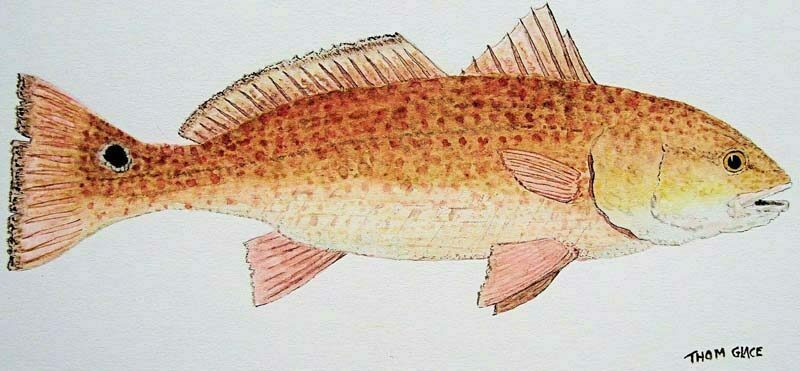
Redfish study by Thom Glace. Used with permission.
Why it works
The virtue of Flip’s system is not complexity. It is durability and consistency.
- The fly-line-to-butt connection can remain in place for seasons.
- The first substantial step-down often needs little attention, too.
- Only the tippet is routinely consumed and renewed.
- Casting performance stays more predictable because the core leader architecture does not gradually become a series of clipped-off, improvised sections.
For salmo anglers, the exact lengths and diameters will naturally change with line size, fly size, wind, current, and whether the presentation is a small summer fly or a heavy, water-loading tube fly. But the logic remains the same: match the butt to the line, reduce material in orderly stages, and reserve routine replacement for the terminal section.
That is the useful freshwater lesson in Pallot’s saltwater system—not a rigid recipe, but a durable method for preserving the energy that the fly line has already earned.
Sources:
Flip Pallot and Brian Flechsig video
Sponsored