


Anglers of yore — mosaic from Leptis Magna, displayed in the Red Castle Museum, Tripoli, Libya. Dated to the 2nd century AD, approximately 1,800 years old. Photo credit: Marco Prins (commons image).
Sometimes, small details make a big difference
By Henry Clement
The junction tubing of a tube fly is a prime example—a small, easily managed component that could significantly impact performance. The length of the tube fly, combined with the junction tube and the hook, determines the total overall length of the tube fly assembly. Proper alignment is essential. Inserting the hook into the junction tubing or deeper into the tube fly can create an offset. This affects how the fly tracks in the water. It is not rocket science. If the hook is not in line with the fly, it is obvious and just needs to be reseated.
There is no rule regarding hook size or construction
Unlike traditional hook-tied flies, the hook in a tube fly is not permanently attached but instead sits within the junction tubing. This allows anglers to customize hook size and shape. And to swap hooks while fishing if a hook becomes damaged, without retying the fly. The combined length of the end tube, junction tube, and hook seating defines the “rear length” of a tube fly. By adjusting these, anglers can achieve the ideal hook exposure for targeting short-striking freshwater or saltwater fish.
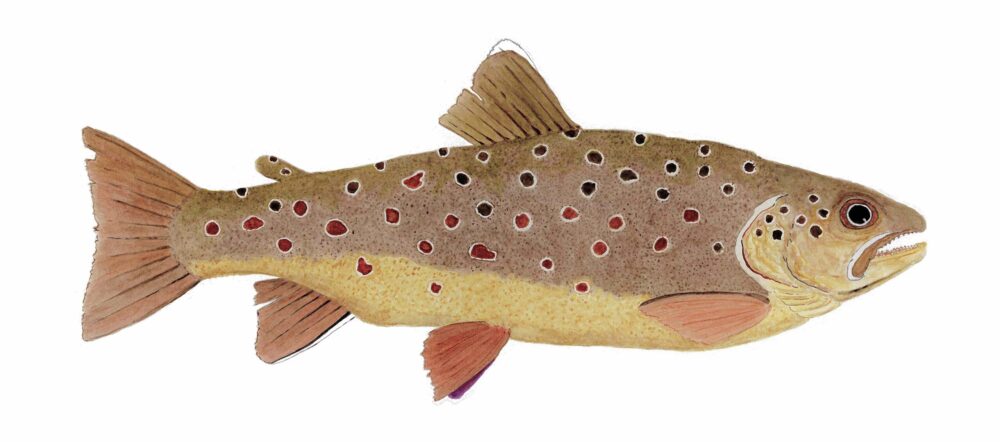
The Gillaroo Trout is found in Lough [lake] Melvin, Ireland. Like the ancient trout species found throughout Europe and eastern Russia, brown trout exhibit a wide range of appearances, as seen in the Gillaroo. Thousands of years of isolation and specialized diet have set them apart in appearance, though the Gillaroo is still a brown trout. This specimen is illustrated by award-winning artist Thom Glace.
One small detail is the knot used to secure the hook in the junction tubing
A slim knot is preferred; bulky knots may not slide smoothly into the tubing and can cause misalignment. The knot used to tie on the hook is part of the overall system but is malleable. Allowing the hook point to face up or down and to be set deeper into the overall tubing. Adding a loop knot, such as the Perfection, is especially popular because it allows for easy adjustment. For example, it can be tied to any desired length.
The junction tubing
Junction tube materials vary, ranging from hard and soft plastic to silicone. While soft plastic provides flexibility, it may flare or loosen its grip after multiple hook changes. This is a concern expressed by guides who rely on tube flies to last through many fish. Fortunately, replacing worn junction tubing is a simple fix, and most anglers will likely not encounter this issue frequently.

Jon Larrabee
Leverage denied
A major advantage of tube flies is that, after a fish is hooked, the fly can slide up the leader. This leaves only the hook for the fish to leverage against. Reducing the chance of the fish throwing the hook. This benefit is not available with traditional hook-tied flies. For this reason, many anglers use loop knots, with the Perfection Loop Knot being a standout choice. It is slim, strong, and has been tested to retain nearly 100% of the line’s strength (as certified by RIO Products and Key West Guide Tom Rowland). Meaning the line will usually break before the knot does.
Here is a selection of knots and their tested and varied reported strengths as tested by the above-mentioned:
- Clinch—89% to 90%
- Improved Clinch—80% to 93%
- Nonslip—80% to 93%
- Perfection—95% to 98% ~ There’s virtually no downside to using a Perfection Loop Knot.
- Trilene—99% to 100%
NOTE: The tested break strength of an improved clinch knot typically retains between 80% and 95% of a fishing line’s rated, straight-pull capacity. The exact breaking point varies depending on the line material (monofilament, fluorocarbon, or braided), the number of wraps, and the line’s thickness.
Professional guide Jon Larrabee
Mechanical engineer Jon Larrabee, owner of HMH Vises—the only entirely US-made fly tying vise. He is also an experienced and licensed guide. He has developed a method to use the Perfection Loop Knot for larger game fish like musky. His expertise can be invaluable; contact him for further advice. Watch the accompanying video to see how to tie the Perfection Loop Knot for tube fly and spin fishing applications.
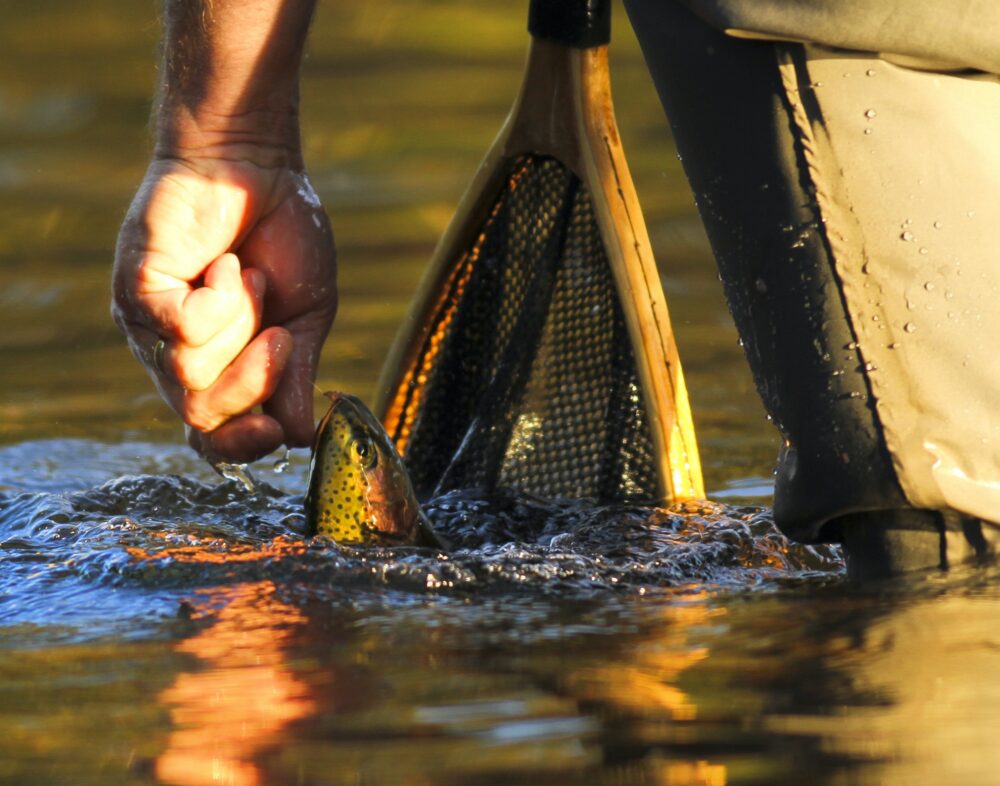
In the water, catch-and-release nymph tube fly. Envato
Every variable interacts:
For example, if your hook rides slightly off-axis, the solution may be to switch to a slimmer knot or trim the junction tube—rather than changing the hook or fly. Tube flies often push anglers and tiers to think deeply about the mechanics of their setup. The knot is a design variable you can control.

For all your tube fly needs, contact HMH here . . .
Watch this ORVIS video on how to make the Perfection Loop knot, your terminal knot
Sponsored