
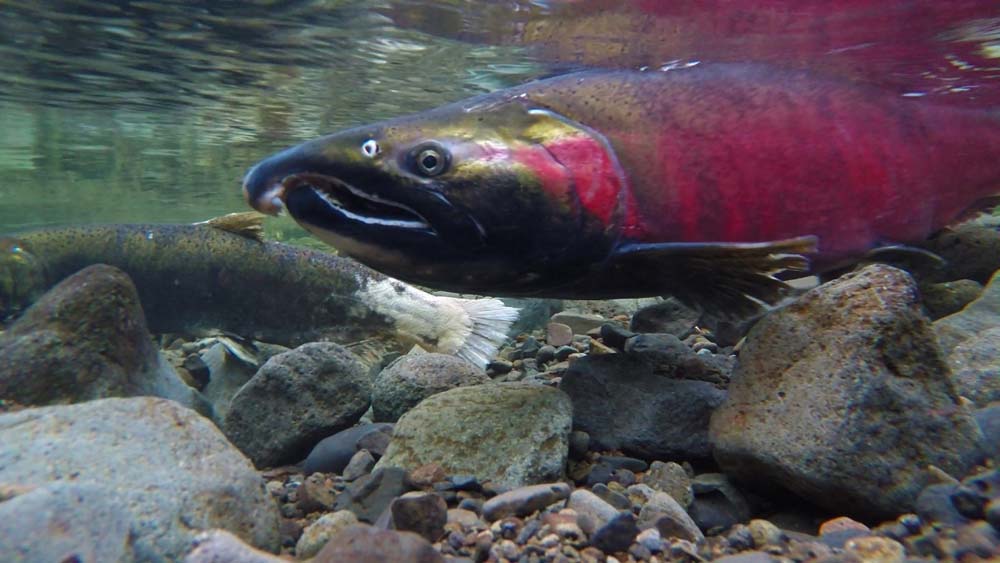

The Chinook salmon (Oncorhynchus tshawytscha) are on a spawning run to historic grounds that were denied to them by dams until now. It is an anadromous fish, the largest species in the salmon family. Chinook salmon range from San Francisco Bay in California to north of the Bering Strait in Alaska, and the waters of Canada and Russia. Photo credit Dan Cook (USFWS).
Klamath Chinook Return

Henry Clement, Rehoboth Beach, Delaware, August 2023.
By Henry Clement
Just when the Trump Administration took the air out of the room on all conservation matters. From granting dirty water and polluted air to corporate donors to ending the Roadless Rule, we have to cheer others on. Why? These days of radio-gaga blaming institutions of government for failing us is the administration’s supposed easy out? Oddly, itself the quintessential administrator of government policy—go figure?
But the good news of the government’s involvement, from Federal to local to tribal, transcends a supposed extinction gone wrong. Of course, Mother Nature had the backs of the Oncorhynchus tshawytscha [Chinook salmon].
The Oregon Public Broadcasting (OPB) provides the most in-depth reporting on Chinook salmon returns to the Klamath River Basin, with detailed on-the-ground accounts of tagged fish migrations, tribal perspectives, and ecological challenges post-dam removal.
Oregon Department of Fish and Wildlife (ODFW) and California Department of Fish and Wildlife (CDFW) outlets delivered comprehensive updates, including radio-telemetry data, spawning observations, and milestone confirmations, such as salmon reaching the Sprague and Williamson rivers.
The New York Times offers a thorough scientific and historical context, covering fish tracking, population estimates, and long-term recovery hurdles, including water-quality issues. NOAA Fisheries details multi-agency monitoring programs using SONAR, radio tags, and netting to track salmon dispersal across 400+ miles of restored habitat.
Klamath Tribes, always taking the long view, kept the pressure on and kept on keeping on. Salmon were a third of the native peoples’ diet that settled along the Klamath River Basin, and for thousands of years, pre—dams that obliterated that food staple. They will regain their salmon.
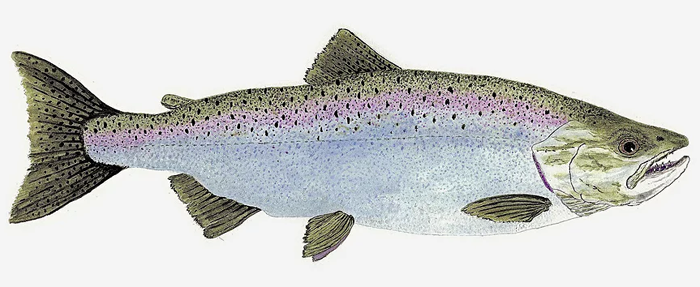
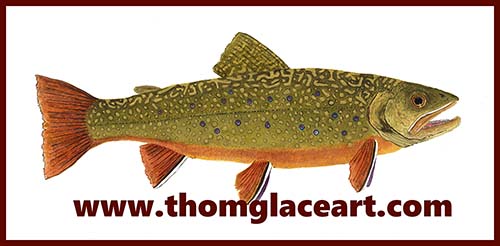
Ocean-run Chinook (king) salmon. A commissioned work by Thom Glace.
Here are some details from multiple sources
Fall 2025 Chinook salmon returns in the Klamath River basin show a substantial increase over 2024, with weir counts on the Klamath, Shasta, and Scott Rivers exceeding three times last year’s figures, attributed to dam removals enabling access to historic spawning grounds. Over 1,200 adults have entered the new Fall Creek Hatchery above the former Iron Gate Dam site, yielding about 1.27 million eggs from 416 females—four times the prior year’s output. In Oregon’s upper basin, around 140 salmon have reached tributaries like the Sprague, Williamson, and Crooked Creek for the first time in over a century, confirmed via video, radio tags, and cameras past Keno Dam.
Emma Marris delivers one of the most sobering overviews of the return of the salmon to the Klamath. It’s a message to the doomsayers among my tribe of conservationists, with one caveat that underscores her belief in nature and salmon’s endurance. However, she ends by reminding us that we cannot keep pissing in the water and expect it to remain potable.
The Salmon That Surprised Everyone

Emma Marris–Photo credit Andrea Lonas Photography.
By Emma Marris — an abridged version
Ms. Marris is the author, most recently, of “Wild Souls: Freedom and Flourishing in the Non-Human World.” She wrote from Portland, Oregon, on November 29, 2025.
“When the last of four dams on the Klamath River in southern Oregon and Northern California was demolished in October 2024, everyone who knew the river well had a question: How long would it take for salmon to reclaim the upper reaches they’d been cut off from for more than 100 years?
About ten months later, when they began their fall migration, Chinook salmon immediately took advantage of their new river access, looking for places upstream to lay or fertilize eggs. But the fish still faced two intact dams, and no one was sure if the salmon would make it through the fish ladders, structures designed for trout, a smaller species, to bypass the dams. Then, in September, a video camera caught them leaping up the ladders like pros.
William E. Ray Jr., chairman of the Klamath tribes, whose people used to rely on salmon for about a third of their diet, told me he was stunned to see the fish make it all the way to Upper Klamath Lake in Oregon in October.
And they are back in the hundreds. Mark Hereford, an Oregon state fish biologist, told me he didn’t expect this magnitude of fish to return for a decade. Salmon are tough, and they’re a reminder that, although nature is sometimes very fragile, decades of conservation rhetoric may have overstated that fragility.
Nature can bounce back, often quickly
Many species and ecosystems can rebound even when we take relatively simple actions to protect them: Look no further than the bison, striper bass, elephants, humpback whales, egrets, bald eagles, and many others that demonstrate recovery is possible.
Entire ecosystems can recover quickly, too. In 2009, the ecologists Holly Jones and Oswald Schmitz calculated that two-thirds of ecosystems recover at least partially from major disturbances. Of those that do, nearly all can recover in about 10 years on average.
When humans stop activities such as logging, trawling, and pollution, water ecosystems immediately begin to bloom with life, though they may never be the same as they once were. Take the vast forests of the northeastern United States, which were cut down for agriculture and logging, then eventually grew back after farmers expanded westward.
Landscape changes can be challenging for us nostalgic humans, but we should appreciate them as expressions of nature’s vitality and intelligence. For many ecosystems and species like the Klamath Chinook, the actions required are straightforward: Don’t build over or plow under their homes, stop shooting or poisoning them, and, wherever you can, blow up the dams.
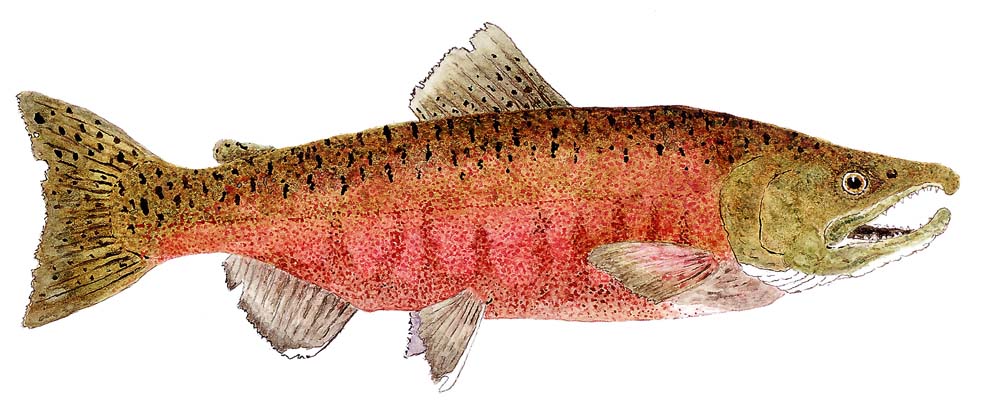
Male Chinook [king salmon] in spawning colors. Illustration by award-winning watercolorist Thom Glace.
The rewards are great
Not only have the Chinook salmon returned to the Klamath River Basin, but they may also soon return to the dinner plates of tribal members, restoring a central part of their culture lost for over a century. We should not give up on any existing species, nor should we allow ourselves to slide into a facile despair that nature is ‘doomed.’ We should always look for ways we can help or, even better, get out of the way and let nature come roaring back.”
Video, salmon are home
Sponsored