

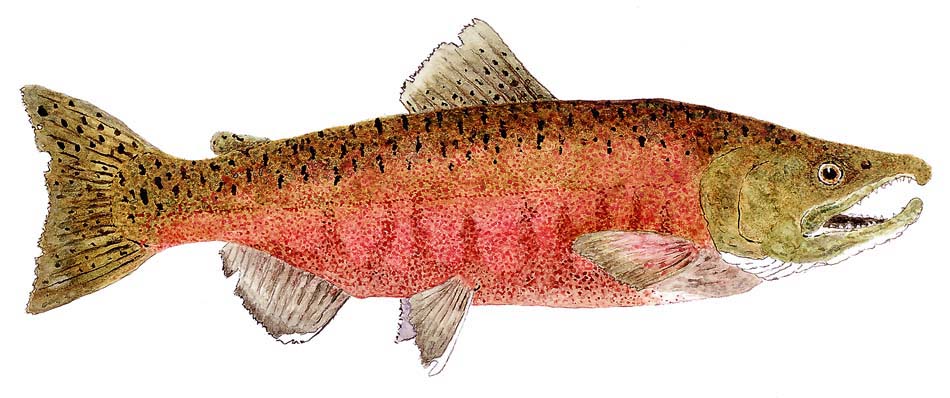
Thom Glace’s Male Chinook [king salmon] salmon in spawning colors. Visit Thom’s site here. . . .
The five principal species of Pacific salmon—chinook (O. tshawytscha), coho (O. kisutch), sockeye (O. nerka), pink (O. gorbuscha), and chum or dog salmon (O. keta)—all exhibit this anadromous life cycle. While some populations of other species (such as kokanee, the landlocked form of sockeye) have adapted to remain in freshwater, Pacific salmon’s typical and defining behavior is anadromy. In summary, the Pacific salmon—except for rare landlocked forms—are universally anadromous.
The Vanishing Salmon
By Clark C. Van Fleet, May 1961
The Atlantic Monthly Magazine / NOTE: The following is abridged. To read the complete story, join The Atlantic with a subscription / accounts.theatlantic.com

Clark C. Van Fleet (1890–1969) was a Californian sportsman, author, and conservationist known for his writing on fishing and his dedication to protecting the Pacific Coast’s forests and rivers. Photo Atlantic Magazine referenced the article.
An Abundance of salmon and trout
“The salmon are exceedingly fat and strong when the homing urge strikes them and they enter the rivers. Once in fresh water, they seldom if ever feed. By the time they have reached the spawning beds, their stomachs have atrophied and, empty of food, no gases form, so that they remain on the bottom as their bodies disintegrate. Practically speaking, they melt away with the active assistance of copepods, animalcules, various larval insects, crawfish, trout, and other predator fish. I well remember my first sight of a stranded carcass in a deep eddy in the McCloud River in California. I was probably twelve years old. A phalanx of trout two pounds and less jostled each other in the current below. The thick, leathery skin of the salmon still held the body together, but the flesh was slowly melting away. Occasionally, a big trout would leave his place in the line and, at speed, strike the side of the carcass with a sharp thump, then dart with exceeding agility back to his vantage point at the rear. A veritable cloud of flakes and numerous insects would drift downstream after each blow, and below them, the trout, and further down, young salmon, were busily darting here and there picking up the morsels of food so released. I watched all this with fascinated absorption, not realizing until years later how nature had provided that, even in death, the mature salmon was to become a banquet table for its own progeny in preparation for the long and hazardous journey back to the sea.
At 12 years old
In the California of my youth, every stream, creek, and brook teemed with trout. I have seen the Garcia River, near Point Arena, so full of rising fish that the surface seemed peppered with raindrops from a heavy shower. The rivers and tributaries were black with salmon, packed in the holes and breasting the shallow riffles in avalanches of broaching fish. I have driven in a buggy along the roads of Marin County and counted sixty-eight cottontails to a mile—just along the road—of an early morning, while the occasional bare hillside was covered with quail, often six to eight hundred in a flock. I have hunted ducks near Colusa in the Sacramento Valley, where, as dawn revealed the scene, the view of them was obscured by the myriads of wild fowl flashing from the first gunfire. All of this, only forty years ago.
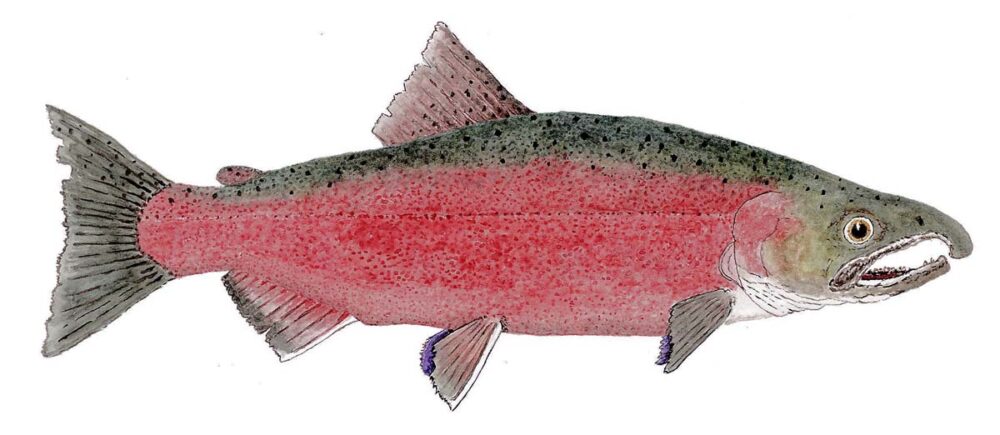
The illustration of male coho salmon in their spawning colors is created by the award-winning watercolorist, Thom Glace.
Nobody listened
Now the trout streams of the state are mostly bare of fish until the Fish and Game Commission truck edges up to the bank and empties into the holes “chamber of commerce” trout which are classed as catchable size (seven to eight inches). Following the truck is a line of cars, whose occupants rush to the bank to be the first to drop a line. A grand sport for women and children, but hardly man-sized. For gunners, pheasants are raised in pens for each fall’s shooting season, released just before the opening, and, often, about every two weeks during this season. Then the pheasants, not yet acquainted with the habitat, never having heard a gun, scarcely having learned the use of their wings, come under the guns of the doughty hunters. The grandest sport of all for the scattergun enthusiast is duck shooting from a blind — the wait in the darkness for the light to break, the whisper of wings, the quacking of unseen birds, the hurtling bodies in the half-light, the swing, and the trigger pull. But nowadays most of the good marshes are pretty crowded, and the birds are spooked before they come into reasonable range. Hence, magnums have begun to replace standard range shells. The magnums drive the birds higher and spoil any chance there might be for a decoy to work. Besides, limits have been cut to the bone, lease blinds on flyways are very costly, and owning your own lake is only for the quite wealthy. Still, the pheasant and duck population can be rehabilitated by care, stringent regulation, and good sportsmanship.
Breaking bad
With the Pacific salmon, the case is entirely different. Dying, as they do, after completion of spawning, access to their native streams must be continuous and unimpeded. If the chain is broken by filth, pollution, obstructive high dams, or continuous harassment, that run of salmon in that particular stream or watershed never returns. The cycle is broken forever. In my estimation, the former great wealth of the salmon fishery in California is doomed. In Oregon, the main runs are badly crippled but not entirely gone. In Washington, the runs are diminished along the coast and in the waters around Puget Sound, but careful husbandry could even bring about an increase. My advice to Alaska is to heed the lesson so well portrayed in the states to the south of it.”
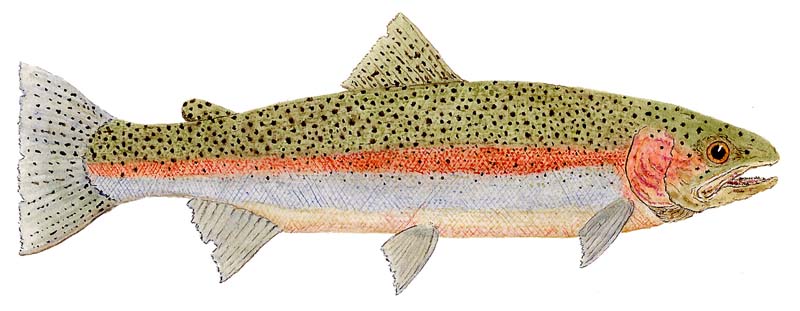
Adult Steelhead illustration by Thom Glace. California: The freshwater form of the steelhead is the rainbow trout (Oncorhynchus mykiss). The difference between these species is that steelhead migrate to the ocean and return to freshwater tributaries to spawn, whereas non-anadromous rainbow trout do not leave freshwater. Steelhead are also larger and less colorful than rainbow trout. Steelhead can weigh up to 55 lb (25 kg) and reach 45 in (110 cm) in length. They can live up to 11 years and spawn multiple times. Other species found in California historically: rainbow trout (including steelhead), golden trout (the state fish, a subspecies of rainbow trout), and cutthroat trout.
Instead, embrace flawed thinking
No one in power is listening, even after the lessons learned. The current administration remains oblivious, and the 80 million MAGA supporters are too proud of their ignorance to acknowledge anything beyond the malevolence of their exclusionary Christian nationalism and their apathetic convicted felon.
Sponsored