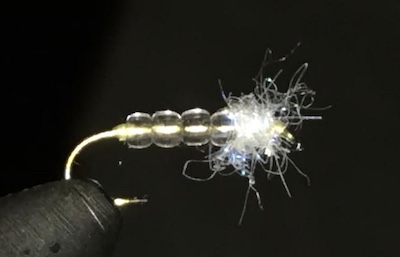

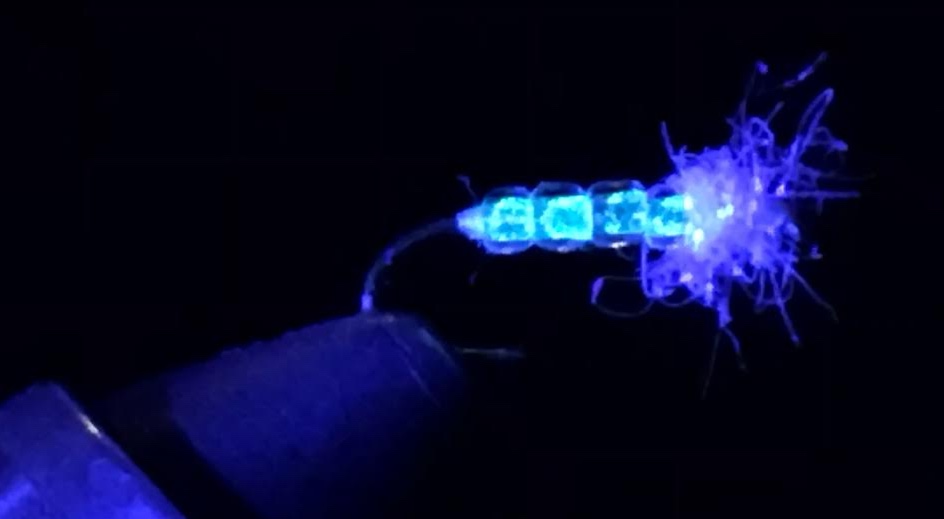
Glow-in-the-dark all-bead larva glowing.

​Testing the waters with glow-in-the-dark flies.​

Steve Hudson, founder of FlyBooks.net, has enjoyed fly fishing, fly tying, hiking, and the outdoors since childhood. The author of more than 30 books and thousands of articles, he knows how important great how-to books, accurate destination guides, and clear, readable instructional material are. That’s what you will find in every FlyBooks publication, too, and Steve wouldn’t have it any other way.

By Steve Hudson, field editor

Halloween is in the rearview mirror now. Did you go trick-or-treating, perhaps dressed as a rainbow trout?
I did not. Instead, I walked a short stretch of creek near here. Even though the water is still low from summer’s drought, I stopped and said “trick-or-treat” to every likely-looking hole or deep spot I could find.

I had some takers. It was a nice day.

On the way home, I stopped by the local market to pick up some creamer. I’ve become hopelessly hooked on coffee, sweet of course and with a splash of vanilla-enhanced creamer for good measure. It’s just the thing for a post-fishing refresher.
Grabbing the creamer, I headed for the checkout. But what’s this? There, below that big sign proclaiming that Halloween goodies were 70 percent off!
A long time ago, I’d discovered that leftover Halloween stuff could sometimes be turned into fly tying material. Those electric chartreuse wiggy things, for instance, are basically just synthetic hair that can be used to make all sorts of great streamers. I’ve caught lots of fish on flies tied with such hair, too, including some nice trout in the local tailwater and, down on the coast, more than a few snook and jacks and reds in the saltwater too.
Alas, I didn’t really need any more Halloween hair. Last year, I’d stocked up with enough to tie perhaps 11,000 flies. But wait. What’s that?

​The tangled web…that glows!

I looked again, and there between the zombie masks and the wizard hats hung a package of spider web material. It was a grayish-white, fiberish material that seemed to whisper “dubbing” — and one can always use more dubbing!
But there was more. This particular fiberish stuff, the package said, would glow “a spooky green.”

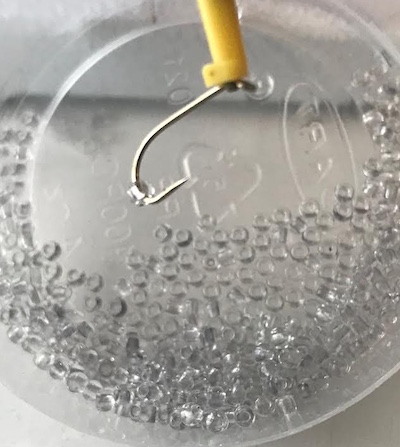
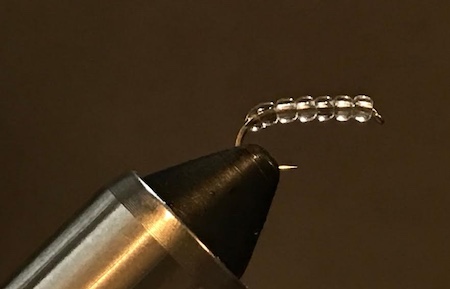
Glow in the dark beads in regular light.

Uh-oh, I thought, and that’s when the wheels began to turn.

I love flies with dubbed bodies. Usually, the goal was to find a color that would be as natural as possible. But what if I took it to the other extreme? What if I tied a nymph with dubbing that was as unnatural as possible?
I couldn’t think of anything less natural than a nymph that glowed in the dark. Would that be a piscatorial turn-off? Or would the glow prove to be an attractor that would draw fish from far and wide?

​Go with the glow

Like most tyers, I wonder sometimes why certain materials work so well nymphs and other subsurface flies even while other materials do not. The key seems to be that elusive something called “bugginess.”
Bugginess is important, for it gives a fly the illusion of life. But to appreciate that illusion, the fish has to spot the fly in the first place.
Anything that makes a fly more visible, I reasoned, might be a good thing. And following that line of thought further, I realized that a little bit of glow might make a fly easier to see among all the rest of the stuff in the water, especially in dimly-lit deep runs or on cloudy, low-light days. Would a bit of a glow catch the trout’s attention and thus catch the trout too?
There was just one way to find out.  I bought a pack of the stuff and headed home to try it out. Glow-in-the-dark flies, here I come!
Driving home, it occurred to me that I could easily take this even further. I remembered seeing GITD glass beads at the local big-box craft store, so I made a brief detour to pick up a bag of them too. The package said they glowed greenish blue, a color which should complement the spooky green glow of the dubbing.

Putting the pieces together

Settling in at the bench, I decided to start simple with a basic dubbed-body larva — a kind of glow-in-the-dark Walt’s Worm, if you will. Using my tying scissors, I chopped up a bit of the spider web material, then combined it with a pinch of soft rabbit for easier handling. The resulting blend twisted onto my thread fairly easily (thanks to the soft and supple rabbit) while retaining the spiky, buggy look that had caught my eye in the first place.
Next, I tied a few more of the same style but this time added one of the glow-in-the-dark beads as a beadhead. The lightweight glass bead did not add much weight, I quickly realized, so I tied a few more with a half-dozen turns of fine, lead-free weighting wire added to the hook shank too.

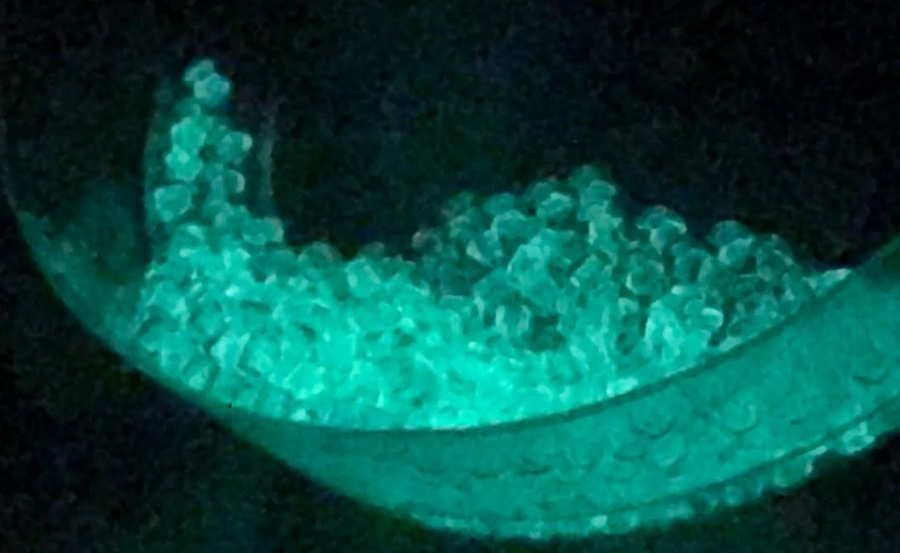
Glow-in-the-dark beads glowing.

Again, the results looked promising.

Next, I decided to try a bead-bodied version made only from glow-in-the-dark beads. This one was a piece of cake. I simply slipped enough beads onto a hook to cover the shank; then I finished with a tiny drop of UV-cure resin at the rearmost bead. A brief blast from my UV flashlight cured the resin — and while it cured, the fly glowed madly under the light.
Encouraged, I moved on to the next iterations – more elaborate bead or dubbed versions, each with a glow-in-the-dark dubbed thorax. The best look, I discovered, came when I made the thorax from coarsely chopped unblended web material. It actually turned out pretty well.
So there they were — several experimental flies that had that certain glow. Now it was time to see if this would work.

What the trout thought

Here in Georgia, where I live, the Delayed Harvest trout season starts Nov. 1 — and now, a few weeks into November, I knew that the local DH waters would hold fish. They should be a perfect setting in which to try these flies, so off I went on a gray and cloudy afternoon to see what they would do in the water.
I rigged my glowing flies just like I would any nymph, with split shot and an indicator.

Glow-in-the-dark with an added thorax in white light.

How’d they do?

Well, my research was far from scientific. But each of the flies did indeed catch fish.
Did their glow make them more noticeable in the dim, mysterious depths of the runs and pools I fished? Maybe so — or maybe the trout were just hungry. The important thing is that, for whatever reason, those glow-in-the-dark, Halloween-inspired flies seemed to work.

That was good enough for me, so I went home and tied up some more!

I also started thinking about what other holiday-inspired tying surprises might be waiting in the wings. A Thanksgiving Trico? A Christmas Chironomid? A New Year’s Nymph? A Valentine’s – well, a Valentine’s something?

I’ll let you know!


​Fly Recipes:

Glow-in-the-Dark Dubbed-Body Larva

(with or without beadhead)

Hook: Size 10-16 nymph hook

Thread: 6/0 or 8/0 black

Bead (if used): A single glow-in-the-dark bead. A non-glowing metal bead can also be used, but a glowing bead is so much cooler!

Body: Glow-in-the-dark spiderweb material chopped into dubbing. For easier handling of the coarse spiderweb material, a bit of soft rabbit can be blended with the spiderweb material.


Glow-in-the-Dark Bead-Body Larva

Hook: Size 10-16 nymph hook

Thread: 6/0 or 8/0, but thread may not be needed unless you use it to secure the beads at each end of the body.

Head (front bead stop): Small blob of thread directly behind the eye of the hook. May not be needed.

Body: Glow-in-the-dark beads slipped onto hook and pushed forward. Use enough beads to reach the bend of the hook.

Rear stop (to secure beads): A second small blob of thread…or a drop of UV-cure resin.


Glow-in-the-Dark Bead Body Emerger

Hook: Size 10-16 nymph hook

Bead: Single glow-in-the-dark bead at front of hook. Non-glowing metal beads can also be used.

Extra weight: Several turns of fine lead-free weighting wire around shank.

Thread: 6/0 or 8/0. Attach thread in front of bead body and dub to form thorax.

Body: Glow-in-the-dark beads slipped onto hook and pushed forward. Use enough beads to reach the bend of the hook, but leave a clear area at the front for the dubbed thorax. Note that you will need to secure the rear of the bead body, either with a small blob of thread or with a drop of UV-cure resin.

Thorax: Coarsely-chopped glow-in-the-dark spiderweb material.

NOTE: This pattern can also be tied with a glow-in-the-dark dubbed body.
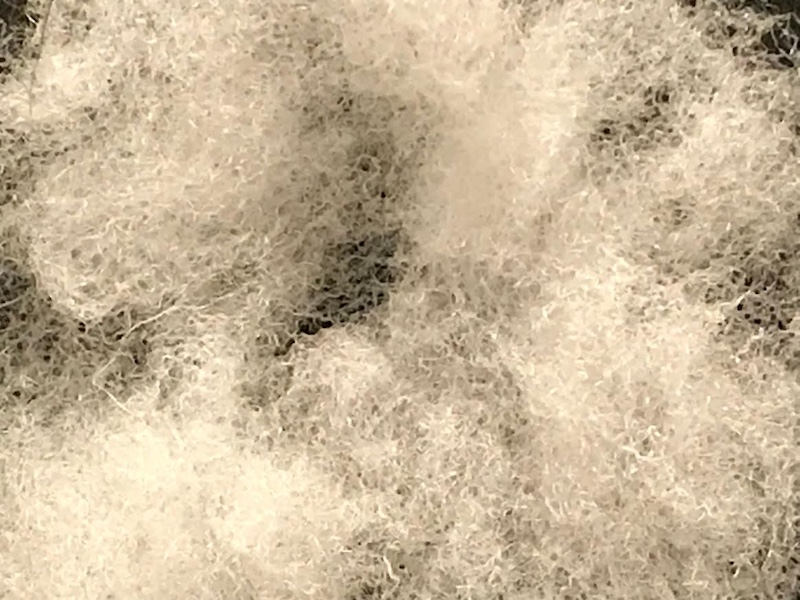
Glow-in-the-dark spiderweb dubbing material in white light.


Sponsored

Skip

Author Skip

More posts by Skip

Leave a Reply

Share
Translate »