


Sunshine Among The Mountain by Charles R. Benedict~2015. Wikipedia Commons image.
Letting the sunlight in
By Henry Clement
Although foreign anglers recognize tube flies as universal patterns that attract fish, their improved effectiveness compared to conventional hook-tied flies is being overlooked. It remains an unexplained mystery.
According to Randy at the best local fly shop near me, Alpharetta Outfitters in Alpharetta, Georgia, “Tube flies require special tying equipment and expertise. They behave differently in the water, and hardly anyone carries them, but fortunately, we do.” From the fly bin, he showed me the one tube fly they had. It was blueish purple, of course, and not a great tie. NOTE: Do not let my sarcasm betray the fact that this fly shop is now the best fly shop in the Southeast U.S.
Randy is knowledgeable in both fly fishing and fly tying. He mentioned that he’s been to Alaska and used, I guessed, the one blue tube fly that he showed me. (Please note that Randy’s comment is paraphrased.)
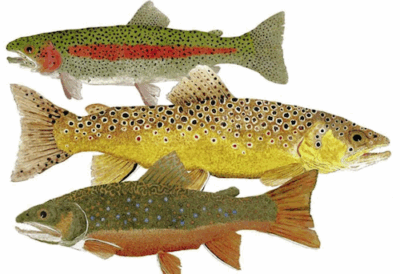
Illustration by Thom Glace – rainbow trout, brown trout, and brook trout. Used with permission. Visit his website here . . .
The enlightened: Ruben Martin and Davie McPhail
Some individuals step up to the plate when tying tube flies, including notable fly-tying experts like Ruben Martin and Davie McPhail. These celebrities are tube fly officiandos who tie for everyday angling in pursuit of salmon, trout, and other game fish around the globe. They understand that tube flies attract a wide range of saltwater and freshwater species from various taxonomic groups.
NOTE 2: Although many of McPail’s tube flies are labeled as salmon flies, according to the long-standing members of our tying club, these so-called salmon flies have proven effective for trout here in Appalachia. Some, like the one featured in the video below, are consistently popular choices. Ruben Martin has an entire series of tube flies and has been tying and fishing them for over a decade.
NOTE 3: You can visit McPhail’s and Ruben Martin’s websites by clicking on the videos.
Books
Currently, there are only a few books dedicated to the history of tube flies, but none touch on the intriguing question:
Are you ‘effing’ kidding me? Tube flies are superior! So, why might tube flies be better than traditional hook-tied flies?
This advantage really depends on a few factors. If controlling the hook type, size, and orientation is important to you, then tube flies could be beneficial. Additionally, if you believe minimizing the hook’s leverage advantage when a fish is hooked is essential, tube flies may be the right choice. Other considerations could include the importance of not losing a fly after a single encounter with a fish and the potential to keep fishing with the same fly for multiple seasons, provided it isn’t lost to a snag.
Moreover, tube flies allow you to replace a damaged hook quickly, meaning you could salvage your fly in just minutes rather than throwing it away.
NOTE4: Several fly tyers in Northwestern America tie tube flies, but their primary ties are only for steelhead and salmon, and sadly, all look alike. They are great people, but stuck in the mud. In the East, Tim Flagler ties tube flies with invention. He is not a tube fly devotee, but he sure is good. You can also catch him on ORVIS’ channel here.

A man looking at signs, a common image by Notas Prenza.
A cappella dumbed up
The issue of segregation is displayed within North America’s prominent angling and fly-tying communities, which, for reasons unknown, often keep individuals uninformed. These professionals may themselves be misinformed or simply following the crowd. Many can be found at fly fishing shows, crammed against the wall at the back of the rented convention center. When asked, “Do you know anyone here who ties tube flies?” they typically respond, “NO.”
Reality is most apparent in the holy lands of fly fishing
Consider visiting Argentina, Chile, or New Zealand, where you can find vast, unspoiled fisheries stretching for miles. Scandinavia also offers rich fisheries that support large native brown trout, Atlantic salmon, and other species such as zander. In these regions, tube flies are highly valued. When using tube flies in Europe, New Zealand, and South America, you are unlikely to have anyone ask, “What is that fly?”
In the US, anything different is beginning to demand a DOJ investigation with FBI support. No wonder tube flies are avoided if they are used for anything other than salmon, billfish, or steelhead.
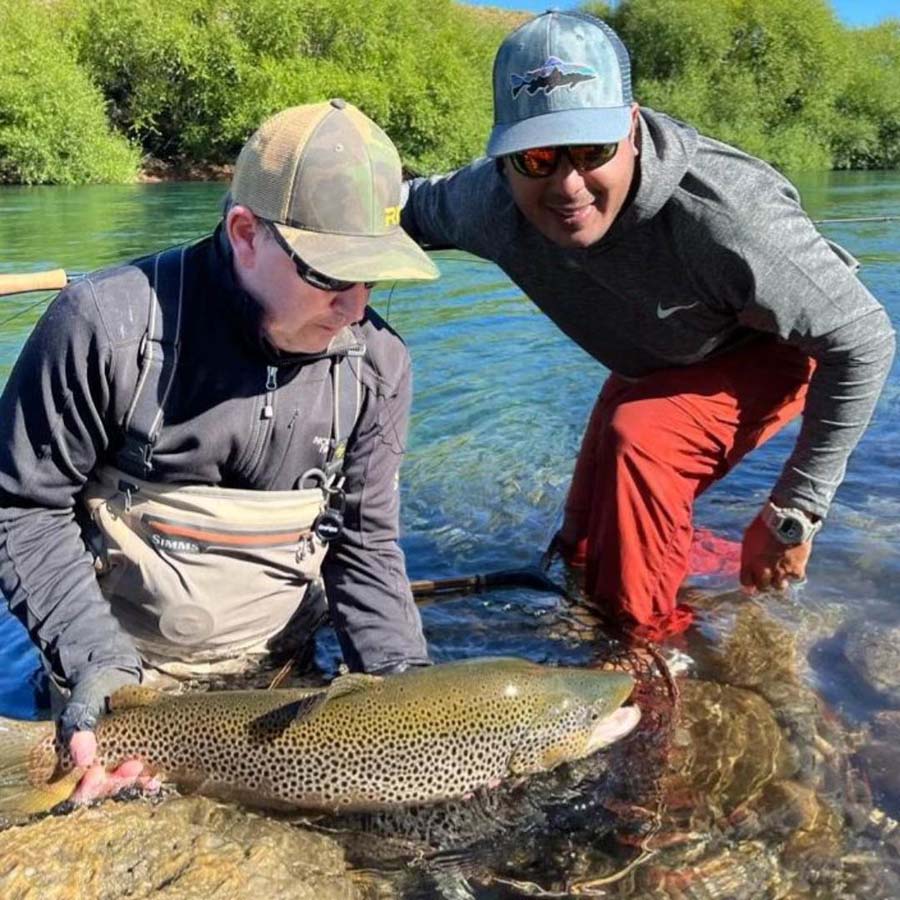
Rubén Martín, reconocido atador de moscas a nivel mundial, instructor de caza y conservacionista con el guía Facundo Pomponio, sosteniendo una hermosa trucha marrón capturada usando una mosca tubo atada esa misma mañana. Foto de Martín.
Uniformity, is it the only thing?
For decades, a huge angling community in the Northwest of the US and Canada has used tube flies to catch North America’s steelhead. Sadly, the tube flies tied in that geography all look like the same person tied every fly, except for a few daring ones who use materials other than blueish purple [which obviously works].
Arriving in the Show Me State, and then Easterly, tube fly blindness obstructs vision and hearing, resulting in a refusal to listen.
Encouraging fly fishers to transition to tubes has been a decade-long challenge with little success to celebrate.
Tube flies are used with spotty success in the Great Lakes tributaries for the same trout species and non-native salmon.
There has been a slow adoption of tube flies among US and Canadian anglers, partly due to the influence of YouTube and those who engage in fly fishing beyond North America. A small community of affluent individuals, exposed to international fly fishing guides offering tube flies for better hook-ups, has been spreading the word. This group often includes people who might not even tie their flies, but they share their experiences within their social circles—just like I did. It’s more effective than osmosis.

Davie McPhail is tying the CdC Olive. Patrick Tillard’s image.
But ya gotta have balls
A fly tier with established US influence championing tube flies would quickly gain Lefty-like status. It would be like knowing the lottery number before the drawing.
You are allowed to improve your angling
There is no underlying reason tube flies should not have significant numbers in every fly box (a pocket would do), no matter the prey, or whether a dry fly, streamer, or other: six-inch-long and articulated fly, or a size-20 grub fly.
Davie McPhail video . . .
Ruben Martin Video . . .
Sponsored