
Flies for fishing, not flies for fly fishers

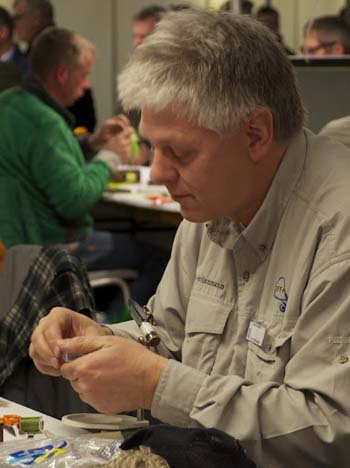
Henry Clement, Rehoboth Beach, Delaware, August 2023. Photo by Captain Andrew Derr.
Most fly tiers may not need an introduction to Hans Weilenmann, but those who don’t know him deserve one. Swiss-born in 1954 and raised in the Netherlands, Weilenmann became a fly fisher, tier, casting instructor, and writer—and one of the most influential popularizers of CDC (cul-de-sac) in modern trout-fly design. His reputation rests less on ornate display tying than on handsome, functional, impressionistic patterns: flies built to fish well, float or sink properly, and survive actual use.
After what he calls his early “no-holds-barred years” of accumulating fly boxes—so many that his vest became, he joked, “a source of concern for many of the major airlines”—Weilenmann deliberately pared down. He began producing flies that would catch fish across a wide range of conditions: uncomplicated, yes, but still elegant.
His credo is blunt and useful:
“I tie flies to catch fish, not fishermen.” — Hans Weilenmann
So what kind of warning was that?
Not long ago, in July 2023, I argued that fly tying is both addictive and an art form. Many flies are tied to be swum, but their number is never called. They become permanent bench players, living out their careers in a fly box, then on a shelf, not remembered, gathering dust. Others were never meant to swim. They were art from conception to completion, and never got wet.
Edward Ringwood Hewitt made the same point nearly a century earlier in Handbook of Fly Fishing (1933):
“Don’t get a raft of patterns. They are not necessary at all and only confuse the fisherman into thinking he must have a certain pattern instead of studying what general shade and size should be used.”
The Tube-Fly Beginner’s Arc
Tube flies have their own version of this arc. You begin sensibly enough. You want to tie a few good patterns. Then the Siren’s song starts playing on repeat, and you yield to the habit of accumulation. Fifty dollars of material becomes a dozen or so seven-dollar flies. Crazy profligate.
An Awakening
My own interest began in Belize in the early 2000s.
Armando, my guide, showed me his tube-fly setup after his clients had landed a week’s worth of tarpon and bonefish—more than triple the catch of the seven other guests fishing conventional hook-tied flies.
His system was beautifully crude: a jury-rigged tube holder, Q-tip stems heated over a lighter to form retaining lips, and lead wire for weight. It was primitive, ingenious, and entirely functional.
That was enough to pique my interest. But at the time, purpose-made tubes, holders, junction tubing, and other necessary materials weren’t readily available. Tying tube flies meant improvising nearly every component, which made the whole business more trouble than it was worth.
Times Have Changed
They are now my go-to system, thanks in no small part to the purpose-built materials and tools available through HMH Tube Fly Products. What once required Q-tip stems, a lighter, lead wire, and a jury-rigged holder has become a straightforward, adaptable way to build flies for everything from tarpon to trout.
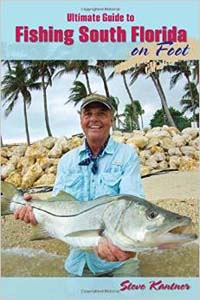
Author Steve Kantner covers ALL of South Florida fishing on foot. Click here for more info…
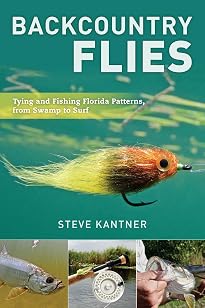
Contact Steve directly for autograph copies … landcaptain@comcast.net
Steve Kantner’s Lesson
Steve Kantner is a useful messenger here. For more than half a century, he fly-fished South Florida, from the Atlantic Ocean to the Gulf of Mexico, and from Lake Okeechobee to Everglades National Park.
As Kantner makes clear, many anglers get out perhaps thirty days a year—or less. They do not need a museum of patterns. They need a small supply of a few proven flies for trout and other coldwater species through the seasons. As well as those animals in the salt marshes and tidal pools and runs.
Anglers who study the water during dry spells and after rain, and who match water temperatures and hatches to weather systems, seasons, tides, and baitfish spawning runs, can fish with purpose. They do not need a thousand flies. They need the right few.
That does not mean Kantner showed up under-equipped. When we fished a particular piece of South Florida water, he already knew, after decades of reference, which dozen flies might work on a given day, season, or tide. He never got it wrong.
That is a testament not only to Steve Kantner, but to the lesson he taught me—and hundreds of clients: study the fishery before you put a line, or a fly, on the water. I highly recommend Kantner’s self-published library of how-to books and stories of times past.
The fly box is not the fishery. The water is
Sponsored