

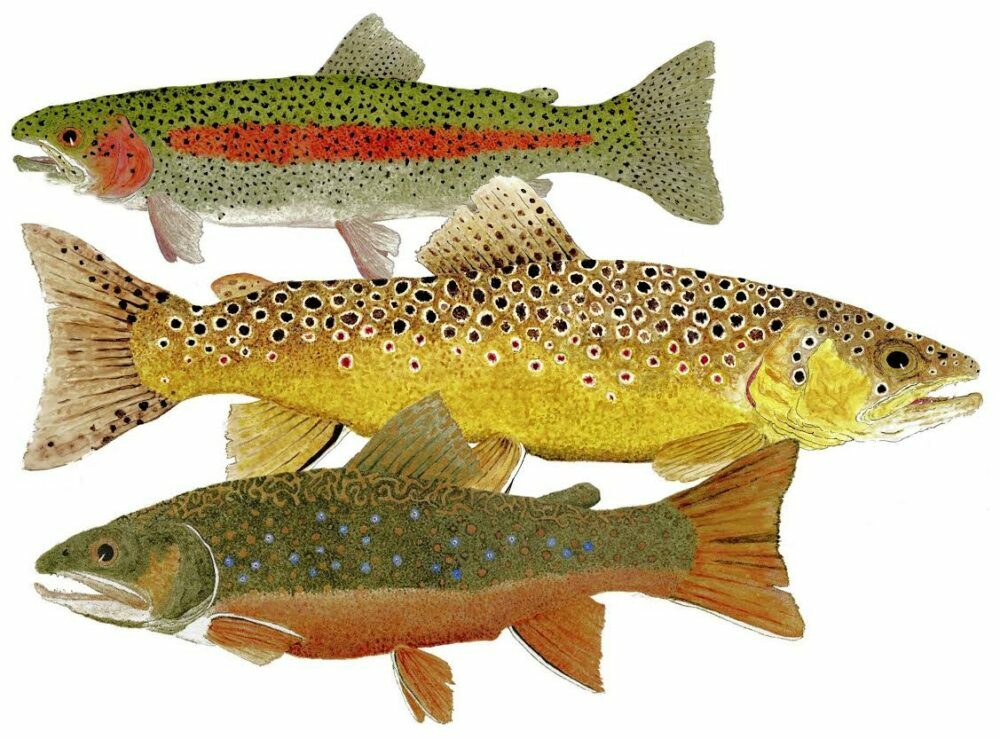
Illustration by Thom Glace – featuring rainbow trout, brown trout, and brook trout. Used with permission. Most of Glace’s illustrations are available in a variety of sizes and presentation options, both framed and unframed. Additional products include coffee mugs, shirts (all sizes), cards, and more.

Henry Clement, Rehoboth Beach, Delaware, August 2023.
By Henry Clement
Not long ago, tying a tube fly meant rummaging through your house for makeshift materials—pen tubes, Q-tips, WD-40 straws, or bits of old medical tubing. There were no fly shop supplies, no online orders for tube-tying gear, and certainly no standardized tubing in a range of diameters or materials. Junction tubing, a simple innovation that allows today’s tube flies to slip free of the hook during a fish-fight, didn’t exist. There weren’t dedicated tube vises, only basic adapters to anchor your improvised tubes.
Tiers had to wrestle with tubes sliding on needles, melting plastics with unknown flammability to create simple lips, and making do with whatever was at hand. It was a hassle. But the results were undeniable: tube flies caught fish. They caught billfish, Atlantic salmon in Scandinavia, Chinook and steelhead in the Northwest and Great Lakes, and eventually every species from blue marlin to crappie.
The claim was true
Still, the difficulty label stuck. In the absence of purpose-built materials, tying tube flies was an exercise in engineering before it could be one of creativity. Fly shops couldn’t easily stock or demonstrate tube systems that required improvisation. Guides, pressed for time, defaulted to familiar patterns. The phrase “they’re hard to tie” became received wisdom, repeated until it hardened into doctrine. What began as a necessary workaround became a reputation, and that reputation endured long after the original obstacles disappeared.
In truth, the problem was never the concept of tube flies, but the lack of standardization. Without dedicated materials, tiers faced obstacles in alignment, stability, and durability at every step. Most anglers, faced with a high barrier to entry, simply chose not to engage.
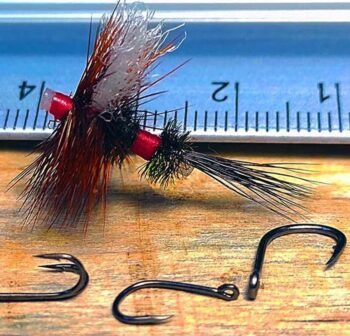
By Ruben Martin.
Today, the complaint is passé
The ecosystem eventually caught up. Standardized tubing, junction materials, and simple vise adapters appeared, and the engineering barrier vanished. What remained was a platform for fly design that was highly adaptable, efficient, and often superior: reduced leverage in fights, extended fly life, customizable profiles, hook interchangeability, and versatility across species and environments.
The irony is that tube flies were never inherently difficult—they were just ahead of their time. Like many good ideas, they suffered from arriving before the tools, supply chain, or industry recognition. And, as with so many things in fishing culture, perception lags behind reality. Today, the advantages of tube flies are clearer than ever, yet the myth of difficulty persists in some circles.
Perceptions can outlive reality
History shows that what is dismissed as “difficult” is often just misunderstood. Tube flies didn’t fail because they were complicated; they were called complicated at a time when, in practice, they were. That perception outlived its cause, but it’s no longer true. For anyone interested in tying tube flies today, everything you need is available.
 Jon Larrabee—owner, engineer, and canoe fly-fishing guide at HMH—is a supplier of all things tube-fly-related.
Click here…
207 729-5200
432 Elm St, US Rt 1, Ste H, Biddeford, ME 04005

Sponsored