
The first sign something had gone wrong with fly fishing was the gold-plated fly rod.

Henry Clement, Rehoboth Beach, Delaware, August 2023. Photo by Captain Andrew Derr.
By Henry Clement
The first sign something had gone wrong with fly fishing was the gold-plated fly rod. It appeared on a livestream titled “THE GREATEST CAST EVER MADE,” featuring the new face of angling—tan, loud, and deeply confident—holding the rod aloft like a trophy. He declared that nobody, in the history of fishing, had ever cast better. “People are saying it,” he added, though no one was quite sure who those people were.
Behind him, the river itself seemed to struggle to remain scenic, its banks littered with branded banners and camera crews.
“Fly fishing has been a disaster,” he continued. “Total disaster. You’ve got these so-called experts telling you what flies to use, when to fish, how to fish. Sad! We’re bringing COMMON SENSE back to the river.”
Within weeks, everything changed.
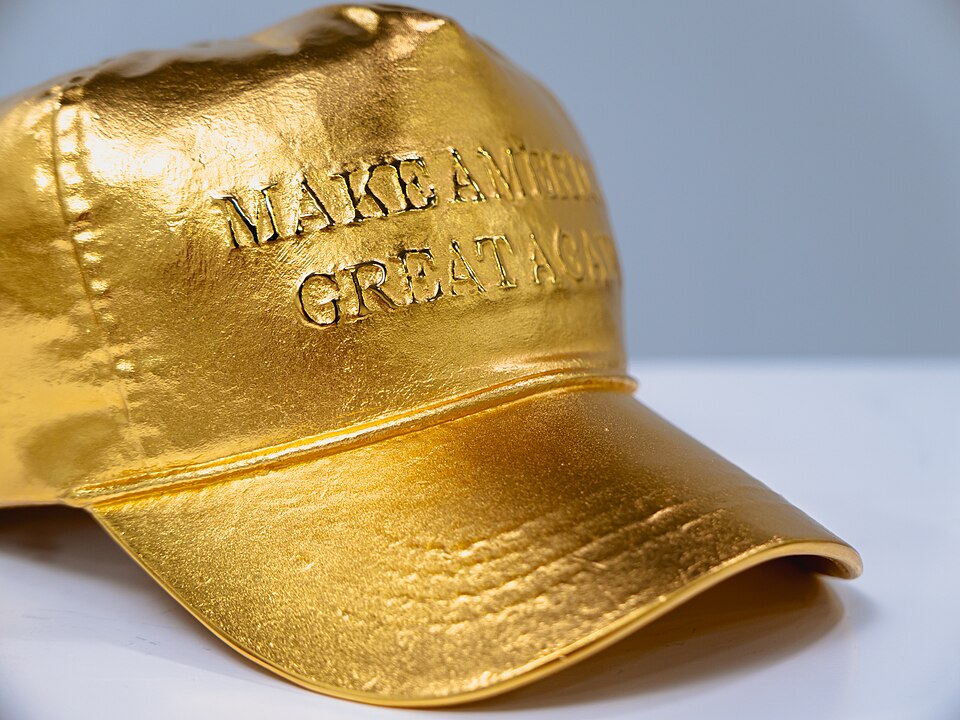
The hats came first: red, block-lettered “Make Angling Great Again” caps, now mandatory at certain “VIP Access Points.” Then came the rebranding of fish. Rainbow trout were fine, but brown trout became controversial. “Why are they brown?” someone asked on a viral clip. “Nobody can explain it.”
A task force was formed.
At rallies—sorry, “Patriot Casting Festivals”—the spokesperson would demonstrate “strong casting,” which mostly involved whipping the line as hard as possible while aides applauded. When the line snapped mid-cast, it was declared intentional. “That’s power,” he said. “That’s what strength looks like.
Meanwhile, actual anglers watched in horror.
Catch-and-release was rebranded as “Catch-and-Surrender,” widely criticized as weak. “You catch a fish, you keep it,” the movement insisted. “Otherwise, what are we even doing here?”
Photos flooded social media
People holding dead fish with triumphant expressions—often incorrectly, sometimes upside down, sometimes with the fish nowhere near water.
River etiquette collapsed almost overnight.
Where there had once been quiet spacing between anglers, people now crowded shoulder-to-shoulder, blasting music and arguing about whose cast had the most “authority.” Someone tried to introduce a bill to rename “matching the hatch” as “domestic insect prioritization.”
Fly shops adapted or died.
One shop replaced its delicate display of hand-tied flies with a giant sign reading: “NO EURO NYMPHING. VERY DISRESPECTFUL.” Another began selling “Freedom Flies”—large, red-white-and-blue monstrosities that scared off most fish within a ten-yard radius.
Scientific input was dismissed entirely.
Biologists attempting to explain spawning cycles were told they were “overcomplicating things.” In one viral speech, a spokesperson declared, “Fish WANT to be caught. Nobody talks about that.”
The crowd erupted. Even the rivers weren’t spared.
At one point, someone suggested straightening a famously winding river because “all those curves are inefficient.” A proposal circulated to install “beautiful, strong current walls” to “keep the fish where they belong.” It was unclear where that was.
And yet, the strangest part was how many people went along with it.
Not everyone, of course. Plenty of anglers retreated to smaller creeks, whispering about dry flies and water temperature like members of a quiet resistance. They shared locations in hushed tones, careful to avoid attention.
But every now and then, the noise found them.
A helicopter would pass overhead. A distant chant—“USA! USA!”—would echo through the trees. Once, a man in a suit showed up to a remote stream, took one look at the water, and declared it “tremendous,” then left without fishing.
One afternoon, a young angler stood by the river, watching the chaos downstream—people shouting, lines tangling, someone giving a speech from a drift boat. “Was it always like this?” he asked.
An older angler, adjusting a well-worn hat that said nothing at all, shook his head. “No,” he said quietly. “It used to be about the fish.”
Just then, a trout rose quietly behind them, unnoticed by the crowd.
The older angler smiled, made a gentle cast, and for a brief moment—just a moment—the river felt normal again.
Upstream, someone yelled, “BIGGEST FISH ANYONE’S EVER SEEN!”
It wasn’t.
Sponsored