
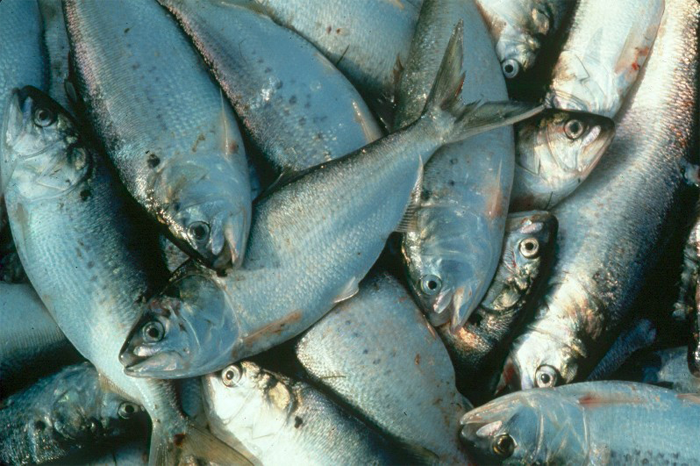
Despite their critical link in the food web, the Atlantic States Marine Fisheries Commission continually raises the menhaden catch quota. Photo by Chesapeake Bay Foundation Staff.
The Last Cast
The morning mist still clung to the surface of the Chesapeake when Ray Holt dropped his line into the water for what he feared might be one of the last times. It was the spring of 2025, and the striped bass — the fish that had defined his life — were harder to find than ever.
Part One: The River He Knew
Ray had grown up on the banks of rivers where salmon and trout ran thick as silver ribbons. His father had taught him to read the water, to feel the cold current, and know where the fish would hold. Back then, the rivers were cold and clear, fed by snowmelt and shaded by ancient hemlocks.
But the hemlocks were thinning now, and the snowpack was shrinking every year. Scientists from NOAA and the University of Nevada had been saying it for years: rising temperatures were steadily eroding the cold-water habitat that trout and salmon needed to survive. Forecasts suggested a 62% decline in suitable habitat by 2100. Ray didn’t need a forecast. He could feel it in the water temperature on his wading boots.
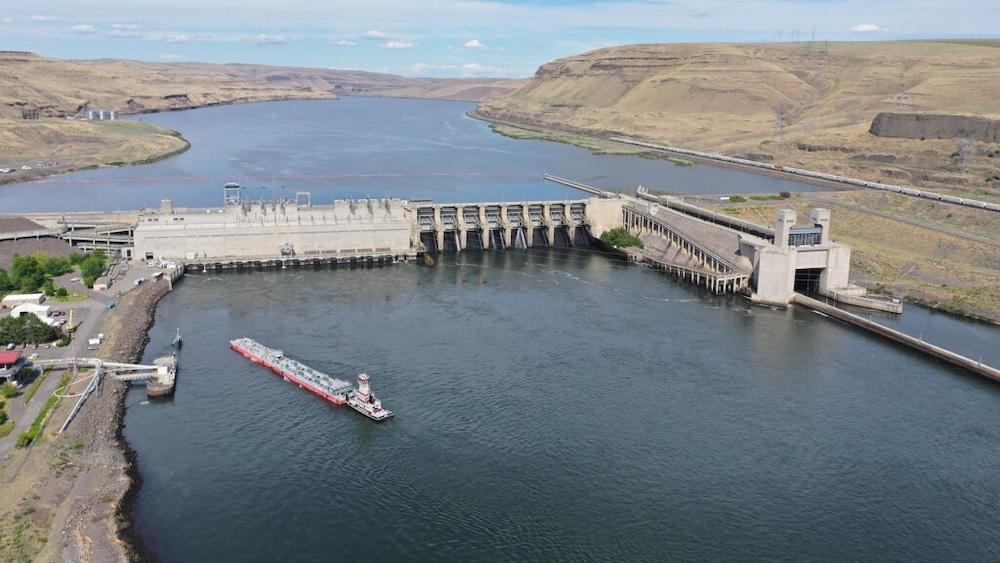
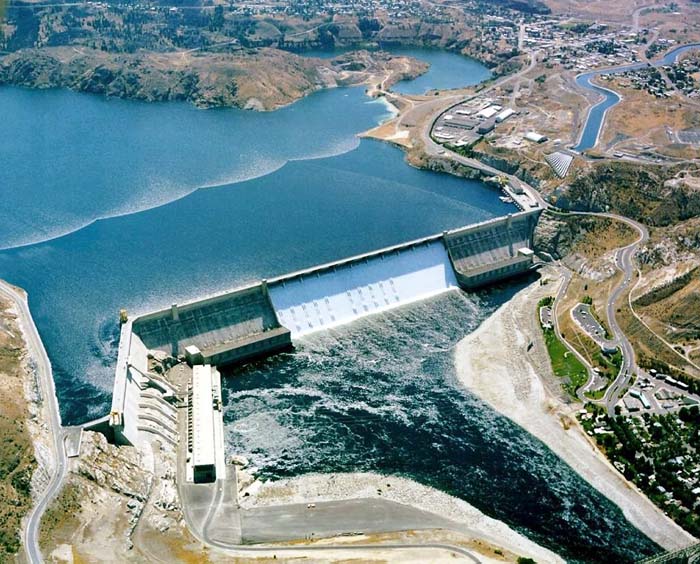
Lower Snake River dams waste vast amounts of water through evaporation. The Lower Monumental Dam on the Snake River in southeast Washington. (Courtesy of the Bonneville Power Administration)
Part Two: The Dams That Would Not Fall
Upriver, three concrete dams still stood — monuments to a century of human ambition. Migratory fish had once moved freely through these corridors, but the dams had turned migration routes into dead ends. Across the Northern Hemisphere, in rivers from the American Midwest to the rivers of Africa, the story was the same. Migratory freshwater fish populations had plunged 81% since 1970.
Ray had signed petitions. He had attended town halls. He had watched environmental groups fight for dam removal while developers and energy companies pushed back. The fish kept disappearing.
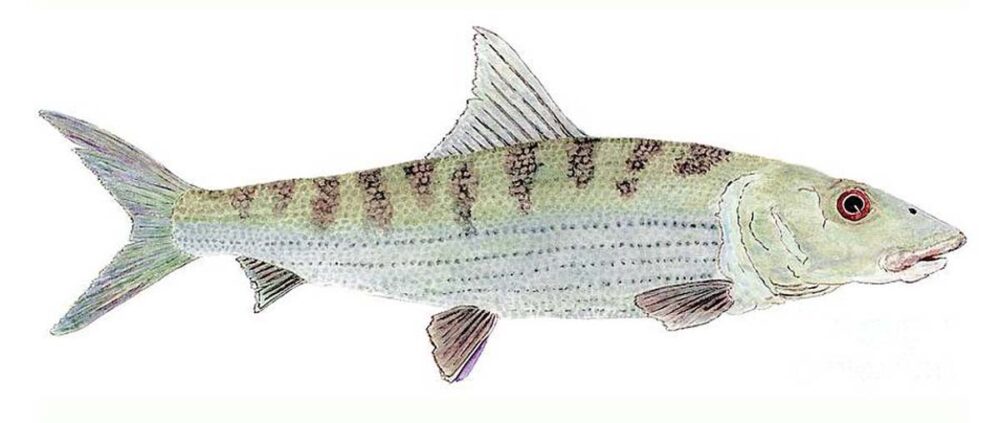
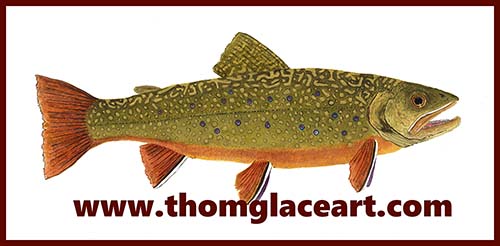
Albula Vulpes. Bonefish illustration by Thom Glace.
…https://www.thomglaceart.com/
Part Three: The Ocean Moves North
Ray’s friend Mara was a saltwater guide out of the Florida Keys. She had watched the bonefish flats change year by year — the water warmer, the seagrass thinner, the fish more skittish and harder to find. The tarpon that once ran predictably through the passes in May were showing up later, or not at all.
Blue marlin were shifting their ranges northward. Coral bleaching had rearranged the underwater neighborhoods that game fish had relied upon for generations. The Atlantic and Gulf of Mexico were running hot, and the fish were voting with their fins, moving toward cooler water.
“The ocean is reorganizing itself,” Mara told Ray over the phone one evening. “And nobody asked the fish if they were ready.”
Part Four: The Regulations and the Reckoning
By 2026, the regulatory picture was a patchwork of crisis management. Striped bass seasons on the Chesapeake had tightened again — catch-and-release mortality in warm water was killing fish that anglers thought they were releasing safely. Red snapper seasons in the Gulf remained brutally short. Stock assessments across regions showed declining populations, and managers were scrambling to adjust bag limits and minimum sizes to give species room to recover.
There was a brief bright spot: bluefish regulations had loosened slightly, with a two-fish increase in bag limits for private and for-hire anglers. Small comfort in a landscape of contraction.
Meanwhile, federal policy had swung hard in the other direction. The Trump administration had moved to expand commercial fishing, reduce regulations, and open marine monuments to harvest. Scientists warned of overfishing risks. Industry faced uncertainty. The ecosystems that had taken millennia to build were being asked to absorb pressures they had never evolved to withstand.
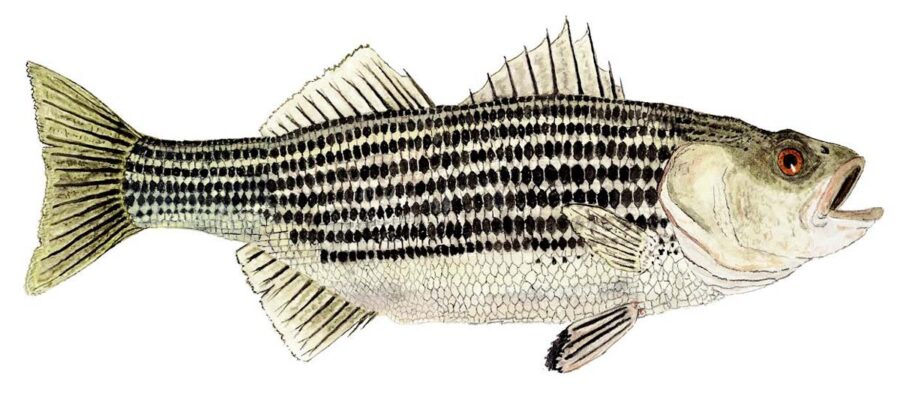
Thom Glace, the award-winning watercolorist, commissioned a striper that is one of the best illustrations of Morone saxatilis.
Part Five: The Choice in Every Cast
Ray reeled in his line as the sun broke over the water. The bass were out there — fewer, deeper, shyer than before. A 2025 study had found that recreational fishing pressure, in some scenarios, was hitting fish populations harder than climate change itself. That had stayed with him.
He thought about the boast — the grip-and-grin photo, the kill shot, the cooler full of fish taken for pride rather than need. He thought about the mangroves being cleared for condos, the estuaries silting up, the wetlands drained for parking lots.
Every angler, he realized, stood at a crossroads with every cast. The fish did not have a vote. The river did not have a lawyer. The future of the flats, the streams, the bays — it lived or died in the choices made by the people holding the rods.
Ray tied on a barbless hook, made his cast, and hoped.
Based on research from NOAA, the Food and Agriculture Organization of the United Nations, the International Council for the Exploration of the Sea, Global Fishing Watch, GEOMAR Helmholtz Center for Ocean Research Kiel, ScienceDirect, San Diego State University, Oceanographic Magazine, and the University of Nevada, Reno.
— Henry Clement, 2026
Sponsored