


The environment we could lose if data centers keep running unchecked. Polling into position to cast — Envato image.
Carbon Emissions of Biggest U.S. Data Centers Already Rival That of Entire Countries.

Henry Clement, Rehoboth Beach, Delaware, August 2023. Photo by Captain Andrew Derr.
By Henry Clement, a curated aggregation
A peer-reviewed study published November 16, 2016, in the journal Nature Sustainability estimates that the largest hyperscale data centers emit more than Bolivia and Denmark combined. The study estimates carbon dioxide emissions from the country’s largest data centers since the start of the artificial intelligence boom. Its authors, a team led by researchers from Harvard University, examined the electricity consumption and carbon emissions of 403 data centers from May 2024 to April 2025. — New York Times
The Mid-Terms
Voters across the country backed environmental protections on November 3, 2026, approving measures to protect water supplies, support clean power, conserve land, and help communities withstand climate-fueled wildfires. They also repeatedly voted to block or restrict data centers, according to the New York Times.
That opposition deserves a closer look
Water consumption is a major concern—but it is only part of a data center’s environmental footprint. How much water are we talking about? Pinning down a meaningful water-use figure can feel like trying to pick a winning lottery ticket.
The numbers vary, and the details matter
But uncertainty about a facility’s consumption makes it hard to gauge potential demand. One estimate from the Electric Power Research Institute puts water consumption for a 150-megawatt hyperscale data center at approximately 340,000 gallons a day. Sustained year-round, that would amount to roughly 124 million gallons.
The Environmental Law Institute describes daily cooling-water consumption of more than 300,000 gallons as roughly equivalent to the water use of 1,000 homes. That comparison offers a sense of scale, not a rule that applies to every facility. — Economic Policy Institute
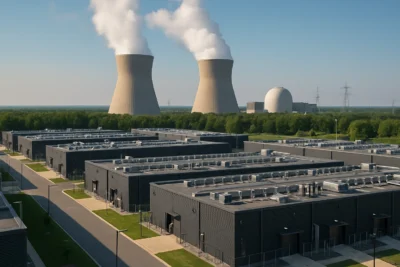
AI Image Data center Wikipedia
The realities of data centers’ environmental impacts, regardless of water consumption
Why location and design matter
There isn’t one universal environmental footprint. A facility’s power supply, cooling technology, and location substantially change its impacts. A project in a water-stressed area raises different concerns from one beside homes or sensitive wildlife habitat.
Reducing one impact also doesn’t automatically resolve the others. For example, cleaner electricity does not eliminate water use, noise, or land disturbance. — Newsweek
Main environmental downsides: Electricity use and climate emissions
Servers and cooling equipment run around the clock. When that electricity comes from coal or natural gas, it creates greenhouse-gas emissions and air pollution. U.S. data-center electricity use rose from 108 terawatt-hours in 2020 to 183 terawatt-hours in 2024. —Pew Research
Water consumption
Many facilities use water to remove heat, including cooling systems that lose water through evaporation. This can strain rivers, groundwater, and municipal supplies—especially during droughts. Water demand varies substantially by cooling design, so not every facility has the same footprint. — Newsweek
Local air pollution
Diesel backup generators emit pollutants when operating; fossil-fueled power plants supplying the facility add pollution elsewhere. That means some of the environmental burden falls near the data center, while some falls on communities near its electricity sources.— Union of Concerned Scientists
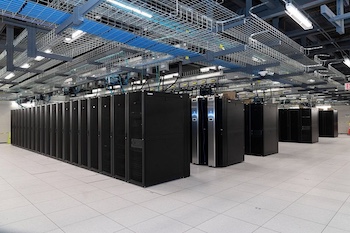
The original Scientific Data and Computing Center (SDCC), formerly known as the RHIC and ATLAS Computing Facility. Original public domain image from Flickr
Land clearing and habitat loss
Large facilities, access roads, and associated power infrastructure can replace forests or other green space and fragment wildlife habitat. The damage depends on whether construction uses previously developed land or relatively intact ecosystems. —Newsweek
Constant noise and nighttime lighting
Data centers can create persistent noise from cooling fans and chillers, with additional noise when backup generators run during testing or power outages. This can disturb nearby residents and interfere with wildlife communication and behavior. Bright nighttime security lighting can also spill into surrounding neighborhoods and habitats, disrupting sleep and animals’ natural day–night cycles. — National Park Service
Waste: Equipment waste and manufacturing impacts
Replacing servers and other equipment creates electronic waste. Focusing only on operational electricity misses the environmental costs of the hardware itself. — Net Zero Insights
Sponsored