

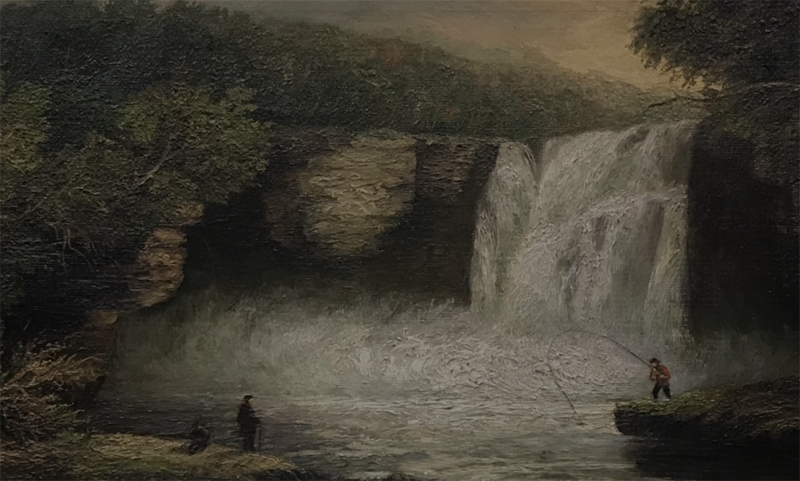
Art exhibition – AMFF.
By Skip Clement / American Museum of Fly Fishing – interview / first published October 1, 2015
Bill Oyster first experienced fly fishing in the northwestern town of Powell, Wyoming. Ironically, it wasn’t until he moved to the warmer climate of north Georgia that his obsession truly took hold. Bill often hiked for miles and camped alone along the crystal-clear trout streams of the Appalachian wilderness. With trout in his backyard, he soon realized it was just a half-day drive to the Gulf of Mexico or the Atlantic Ocean, where he could pursue sea trout, redfish, and tarpon. This area offered virtually limitless opportunities to keep even the most enthusiastic fly fisher entertained year-round.
While attending the University of Georgia in Athens, Bill met his wife, Shannen, who would play a significant role in his success in turning his passion into a career. Shortly after graduating, Bill competed as a professional road racing cyclist. He and Shannen got married and moved to Gainesville, GA. However, just after the ’96 Olympic Trials, Bill suffered a career-ending fall while training. With time and energy suddenly available, he channeled all his efforts into his fly fishing interests. He engaged in various activities within the fly fishing world, from tying flies at trade shows to teaching casting and guiding for local fly shops.
Intrigued
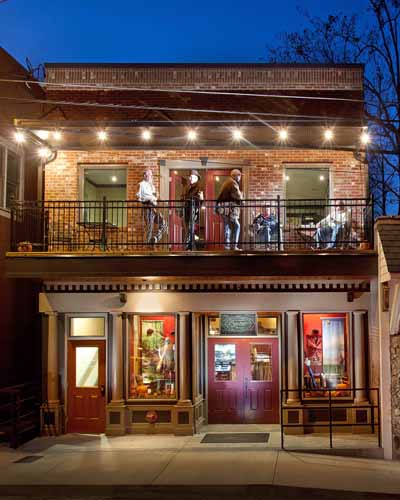
Outside the shop in Blue Ridge, GA. Oyster Bamboo image.
Still, in his twenties, he soon took an interest in bamboo fly rods. He loved the beauty and history and hoped to obtain one for himself. The more he learned about these rods, the more he became intrigued by the craft itself. At that time, there was no one around to mentor his interest in rodmaking and no internet with its endless stream of information. So it was through a small stack of dusty books and countless hours of trial and error that Bill slowly put together his own style of employing these traditional techniques. Each rod produced was a bit better than the one before, and his experience in all manner of fly fishing (as well as his casting knowledge and abilities), quickly put him on the road to creating classic rods that could satisfy a more modern expectation of performance. His art training led to an aesthetic that set a new standard for the kind of beauty that could be achieved in the most high-end niche of the market.
Each year over a hundred students travel from around the world to spend a week with Bill
Still in his twenties, he developed a keen interest in bamboo fly rods. He was captivated by their beauty and history and aspired to have one of his own. As he delved deeper into the subject, he became increasingly fascinated by the craftsmanship involved in rod making. At that time, there were no mentors available to guide his interests, and the internet provided no resources for information. Consequently, he relied on a small collection of dusty books and countless hours of trial and error to gradually cultivate his own style using traditional techniques. Each rod he created was an improvement over the last, and his extensive experience in all aspects of fly fishing—including casting knowledge and skills—set him on a path to producing classic rods that met modern performance expectations. His background in art contributed to an aesthetic that established a new standard for beauty in the high-end niche of the market.
American Mu seum of Fly Fishing interview with Bill Oyster
AMFF: What were your beginnings in fly fishing? Who got you into it?
Bill Oyster: I really just stumbled into fly fishing on my own. Nobody in my family had any interest in it, but I was captivated from my earliest memories. Growing up in northwest Wyoming, I first encountered fly fishing, but at the time, I wasn’t too impressed—my Zebco rod and a can of worms seemed to work just fine for me. It wasn’t until college, when I picked up a fly rod to pursue trout in north Georgia, that I truly appreciated it. I was struck not only by how effective it was (even though I wasn’t very good at it initially) but also by how beautiful the sport is.
AMFF: Why bamboo?
I have always possessed what you might call an artistic sensibility. The allure of a bamboo fishing rod, a wooden sailboat, or a classic motorcycle—these are not things that can easily be explained or justified. It is simply a matter of whether something resonates with your senses or not. For me, it does, and it continues to do so.
AMFF: Are there any rod makers that have influenced your technique?
BO: For me, it was every rod maker who ever wrote a book. I’ve read them all multiple times. I believe Everett Garrison’s book is at the top of the list; it presented the entire process as something serious and seemingly impossible, which motivated me to give it a try!
AMFF: What do you do differently than everyone else?
BO: Interestingly, I believe the biggest difference between myself and other rod makers is that I don’t take the craft too seriously. Fly fishing and creating fly rods should be enjoyable. While I am committed to making the best fly rods I can—because that is what I find fun—I don’t mind if others prefer different styles or techniques. I’m not interested in debating things like tapers or plane sharpening angles. I know what works for me, and I cherish every moment of the process.
AMFF: How did you learn to engrave, and what goes into that process?
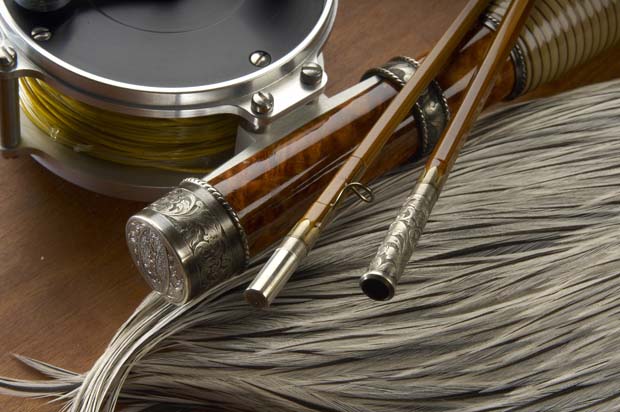
A finished Oyster bamboo fly rod ready to fish. Oyster Bamboo image.
BO: Early on I experienced a demand from my customers for personalization. I took a chance on myself and travelled to an engraving school in Kansas to see if it was something I might be able to do. Fortunately, it stuck. I talk directly to the customer and combine their interests and history with my experience to design and create the custom engravings. I sometimes spend upwards of a hundred hours designing, drawing, and cutting the most elaborate pieces.
AMFF: What is the creative process that you go through when making fly rods?
BO: It all starts with the customer. I need to know how and where they will use the rod. Also, if they have any strong preferences in rod action or feel. All of the practical considerations come first. Only then do we discuss aesthetics. First and foremost the rod must perform properly, consistently, and reliably. Otherwise I might as well just paint them a picture instead! Some are only looking for a simple and understated style, and we are happy to comply. Many of our more complicated rods are ordered as heirloom pieces and my engravings are based on highly personal ideas that will stay in that family for generations.
AMFF: What was your favorite fly rod that you have made?
BO: There is no question that it is the first rod I ever made #001. It took me six months of trial and error, reading and re-reading, head scratching and cussing, but I finally achieved something I had dreamed about for years. I’ll never sell this rod. It’s MY family heirloom.
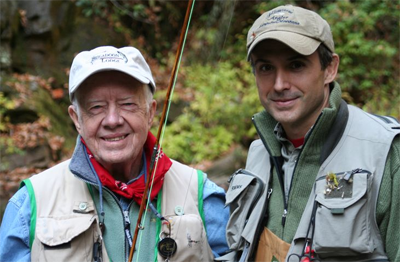
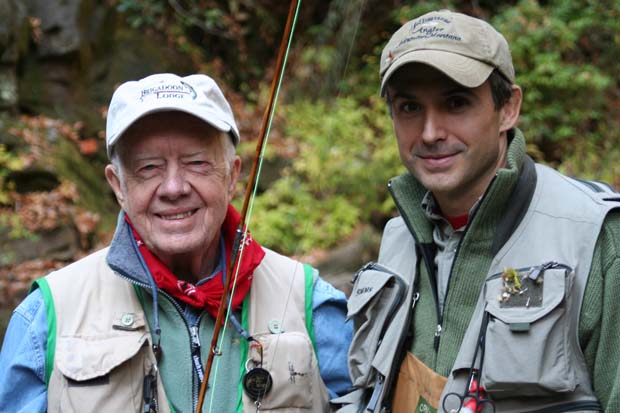
Famous angler, President Carter and bamboo rod maker Bill Oyster in the Blue Ridge trout waters of North Georgia. Oyster image.
AMFF: What was it like fishing with and making a rod for President Carter?
BO: I guided President Carter again last week, and it was a familiar experience—highly rewarding, thoroughly enjoyable, and a bit stressful. He is, after all, a serious fly fisherman, and those large fish don’t always rise when you want them to. However, he is an excellent angler, and we always manage to bring a few to the net. The rods were originally purchased as part of a fundraising effort by the Carter Center. The plan was for him to sign the rod before I varnished it, he would fish with it for a while, and then it would be auctioned off to raise funds. However, after fishing with the first rod for about thirty minutes, he decided that a new rod should be commissioned because the first one wasn’t going anywhere! It was a real honor for a young guy from a small town with just one stoplight, working alone in my basement at the time!
AMFF: Were there any challenges or adversities you had to overcome?
BO: Starting out as a twenty-something in the Deep South didn’t quite fit the stereotype of a bamboo rod maker. Back then, none of the “big” names in the industry paid me any attention. That made me realize I shouldn’t waste time worrying about others’ opinions. Instead, I set out to create rods that were not only excellent in performance but also beautiful, so it wouldn’t matter who made them or where they came from. This philosophy still guides our business today, and I find that with my grey beard, things are becoming easier! In fact, the closed doors I faced when starting out led me to teach rod-making classes. I discovered that turning away enthusiastic would-be rod makers felt wrong, and I didn’t want that negative energy associated with my life’s work. So, I made it my mission to create a positive experience for others. To this day, I’ve helped more people complete their first bamboo rod than anyone else in history, and that accomplishment brings me joy. See how that works?

Bill Oyster is fishing with his brand and catches a nice bow near home. A Hollis Bennett image.
AMFF: What is your favorite fish to go after – do you prefer chasing hard to find fish and experiencing the different places you catch them in or staying local and going after the football rainbows in Georgia?
BO: I will fish whenever I have the opportunity and have certainly dedicated a lot of time to catching local trout. However, much like any addiction, a true enthusiast always seeks more. This year alone, I’ve fished for trout and striped bass in Georgia, bull reds in Louisiana, large browns in Patagonia, and tarpon in the Florida Keys. Next month, I’ll be heading to northern Argentina to pursue golden dorado, and in November, it’s off to Andros Island for bonefish. I am an avid angler through and through.
AMFF: Any special memories from the rod shop or people you encountered?
BO: The shop is my home; where I sleep is less important. Employees, friends, and fishing buddies are one and the same. My wife manages the business aspects from her office, while my kids do their homework surrounded by bamboo shavings. Our dogs greet everyone who walks in. This is where we gather on our days off and meet up before heading out. This place, along with the people who frequent it, enables us to live the life we desire.
AMFF: Are you making it a family affair? Have you taught your kids to fly fish, or have they shown interest in picking up the rod-building torch?
BO: My kids enjoy fishing, as most kids do when given the opportunity. I am careful not to push them too hard, as I want to make sure they continue to enjoy it. I hope that one day they will carry on the tradition, but only time will tell.
AMFF: What are your thoughts on fisheries conservation?
BO: I have seen firsthand the effects of development, deforestation, pollution, and overcrowded waters. This is a problem that we have all contributed to, and we need to find a way to manage it. Mother Nature simply cannot keep up if we continue to act thoughtlessly and carelessly. Unfortunately, there are still people, including some fishermen, who behave as though there is no tomorrow and take without giving back. It is undoubtedly a significant issue, but one that could be addressed if more individuals focused on their children’s futures instead of just their own immediate gains. That’s all for now.
AMFF: Ok. One rod, one reel, one fly, and you’re on a deserted island. What do you take?
BO: Hmm, an island must be saltwater. I’m going to need to eat. I’ll take my 8’9wt Oyster bamboo rod, which is solidly built for durability, along with my trusty Tibor Signature Series reel and a good old Clouser Minnow. Let’s go fishing!
NOTE: The Featured Image of President Carter and Bill Oyster was taken just a few weeks after the interview. The photo credit is assumed to be AMFF.
Join the American Museum of Fly Fishing and keep your fly fishing fever burning . . .
Sponsored



Join the discussion One Comment