


Graphene Carbon Fiber Fly Rods: According to founders Carl McNeil and Jeanie Ackley, as well as new owner Tohru Yamai, Epic fly rods are lighter, stronger, and more responsive. The Epic G-Series fly rods are available in 4-[84grams], 5-[94 grams], 6-[107 grams], and 10-weight [111 grams]. All 9-feet long and four pieces except the 4-weight, which is 8-feet long- Each is $895, not including a rod and reel tube [$130], or shipping.
Graphene is not a lot of much ado about nothing

Henry Clement, Rehoboth Beach, Delaware, August 2023.
By Henry Clement
However, when a fly rod costs as much as a car payment for a lightly used Lamborghini is time to reconsider a life-long passion for fly fishing?
The simple answer is that adding graphene to graphite, along with specific bonding agents (adhesives), brings a new fly rod to life that is more durable, lighter, and has less recovery vibration. The latter has been a frustration for the entire fishing community since before the time of dinosaurs. Not that a poor caster or a poorly designed fishing rod can’t cause any new technology to underperform.
Who are “they?”
Some claim that adding graphene should reduce pre-peg costs, and some believe that manufacturers might lower fly rod prices, which I think is unlikely—and I would not blame them.
Shouldn’t better quality cost more?
Graphene fly-fishing rods will not be cheaper for brands like Orvis, Sage, Winston, or any other company purchasing graphene fly rod blanks. Currently, all graphene-impregnated blanks mainly come from South Korea and Japan. Those countries, especially South Korea (and formerly China), already produce graphite rods for nearly every maker of “fishing rods” worldwide because they can produce better rods than we or the British can. They are far ahead in manufacturing fishing rod technology, not forgetting the wage advantage.

Epic’s Pierre Joubert demonstrates how-to with the 590G 5-weight fly rod.
Okay, where does Graphene come from?
In 2004, two researchers at the University of Manchester, England, Professor Andre Geim and Professor Kostya Novoselov, isolated a carbon-based product which is similar to a standard pencil but only one atom thick. It was arranged in a honeycomb pattern, and they called it Graphene. Their stunning, out-of-the-box scientific feat won Andre and Kostya the Nobel Prize in Physics [2004].
Graphene is an innovative material because it is exceptionally lightweight and stronger than diamond. It is also 100X stronger than steel of the equivalent mass.
In the world of fly rods, it can be integrated into a rod blank that is lighter and significantly strongerand lighter than anything made thus far. This is a breakthrough in fishing rod technology that will not go away.
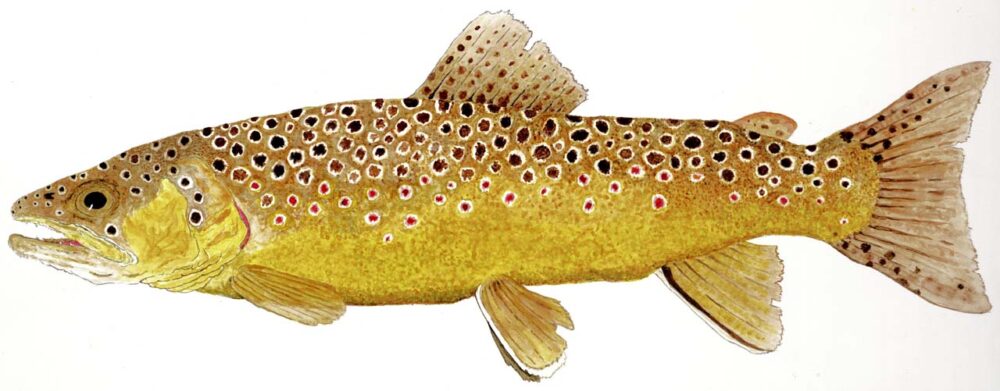
Salmo trutta illustration by award-winning watercolorist Thom Glace. Used with permission.
So, what could a “graphene” fly rod do for you?
From beginners to professionals, a lighter, more durable, and less reverberant fly rod would be more enjoyable to use. Less effort to cast should mean better accuracy—and as the lady said, “I’ll have what she’s having.”
Hey, shorty
I suspect a graphene fly rod could influence fishing rod designs enough to shorten them. For example, an 8-foot 7-weight fly rod would be easier to handle than a 9- or 10-plus-foot 7-weight rod in any situation. Especially so on windy days on the flats, or upstream or downstream quartering casts in a riverine landscape. The potential for shortening fly rods due to graphene properties is something no fly rod manufacturer has yet mentioned they are researching. So far, dabbling around the edges seems to be the industry’s play. A few small companies have followed the lead, and they should be congratulated [see below].

The Evos Saltwater fly rod series, designed by St. Croix, is an advanced carbon fiber matrix combined with revolutionary MITO® Graphene technology. This rod is exceptionally responsive across various casting distances and is noted for its incredible accuracy. It aims to provide an ideal balance of power and precision, ensuring fast action while maintaining a sensitive feel. Additionally, the Evos Salt is said to combine powerful lifting capability, unmatched loop stability, and high line speeds with a smooth feel and excellent feedback.
As is now our national policy thinking, science is not worth much
Perhaps the shorter fly rod idea lacks sufficient merit to consider it as having such ubiquitous properties, or should we now follow the current path, discourage science, and leave that to other nations?
Graphene fly rods – find details and pricing:
- Epic (Swift) Fly Rods: “G Series” graphene nano-resin blanks and finished rods, marketed as lighter, tougher, and more responsive.
- St. Croix Fly: Promotes an exclusive use of MITO functionalized graphene in its in‑house rod-building materials.
- Vision Fly Fishing: Graphene” and “Merisuola Graphene” saltwater and DH series noted as next‑gen graphene builds.
- Taylor Fly Fishing: “Anomaly Z” is described as a graphene fly rod with premium titanium guide hardware.
- Hardy: An early adopter, launching the first graphene-enhanced fly fishing rods, the Zephrus series, in 2016.
- Douglas: Has high-performance fly rods in their lineup, which may include advanced composite materials.
Sponsored