

Stepping beyond the glare is for the curious

Henry Clement, Rehoboth Beach, Delaware, August 2023.
By Henry Clement
More than a dozen years ago, I began enthusiastically searching YouTube for tube fly tiers. At the time, I was living and angling South Florida’s waters for bonefish, snook, largemouth bass, redfish, tarpon, and more. Losing a lot of flies with one catch or one bite, or one and done, turned into frustration.
For many, tying flies is medication and a pure creative experience
Tying flies for others is work, but losing flies on a single bite or a single encounter with a coral outcropping that ruins a hook point is just plain annoying to anyone. There had to be tubes tied regularly for more than just steelhead and salmon.
There is no tube fly community in the US or Canada
Conventional fly tiers in the US overwhelmingly avoid tube flies, but not so much in Canada. Grudgingly and angrily, tying tables at fly fishing shows would sometimes say that tube flies have faults. Asking for specifics usually generated a blank stare or a really inane comment.
Angie Roth to tube deniers:
“The argument that hook-tied flies are better than tube flies recalls the Papacy’s 1633 condemnation of Galileo as a heretic for advocating Copernican theory, which holds that the Earth revolves around the Sun.”
The only consistent tube fly tiers are in the Northwest. Tiers like April Vokey and Peter Charles (Canada), Jay Nicholas, and, of course, Tim Flagler alone in the East, who single-handedly turned up the volume for tubes.
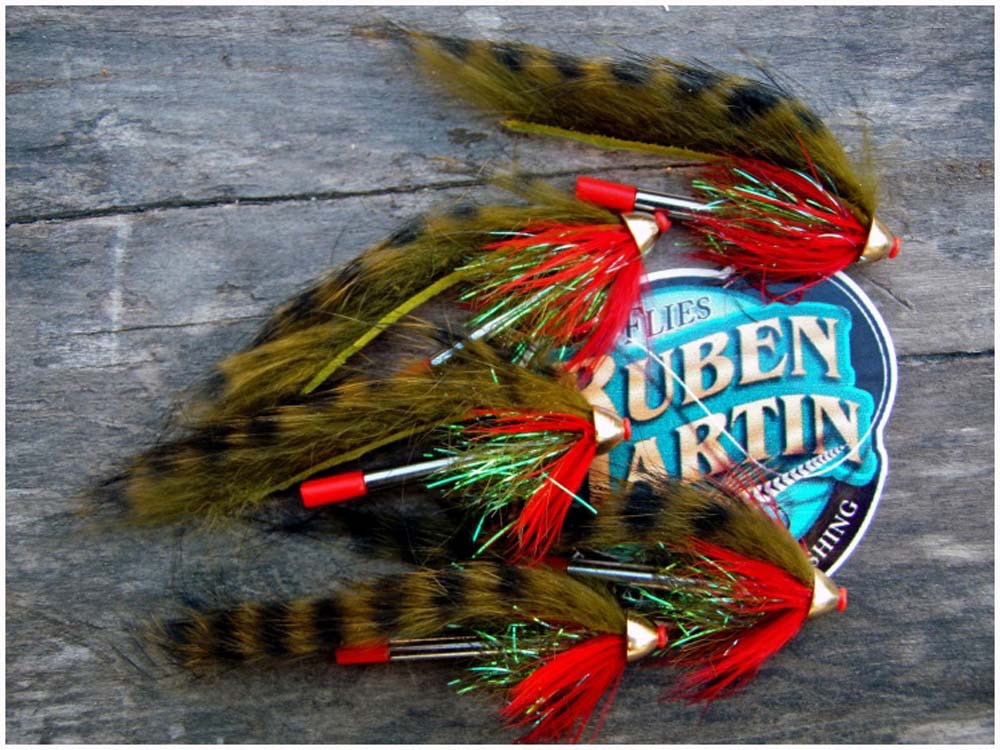
There is a tube tying Guru in Argentina. Tiers of any belief know who Ruben Martin is. He’s been tying tubes for well over a decade. His tips and techniques are fascinating. Click here to visit …
At a fly-fishing show, I met a British angler who referred me to Martin Jorgensen’s Global Fly Fisher. There, I read about Richard Katzman tying small tube flies for Catskill trout. It was a truly transformative experience for me.

Here, April Vokey helps out a fellow tyer at a fly-tying symposium. April Vokey is a modern-day superstar of fly tying. She has made waves throughout the steelhead world as a fly fisher and has made many contributions to tying tube flies.
Getting hooked
I thought a hollow plastic Q-Tip (no longer readily available with a hollow tube) could serve as the host for tying tubes, as suggested by Katzman.
Q-Tips were cheap – pennies
They could be blueflame lighter-heated to both expand the interior diameter to accept larger hook-eyes, and create a lip to hold the thread from sliding off either end, as Katzman predicted.
“Tubes can be made infinitely stealthier and more realistic when hidden,” said Karzman. Learning to bury the tube with thread and feathers takes some skill beyond ordinary tying. That is particularly true of small flies: nymphs, mayflies, caddis, emerges, duns, and spinners tying on hooks as well. Of course, there are larger versions of all of the latter.
Further searching uncovered a wealth of tube information on Scandinavian and UK sites (Davie McPhail). It was clear that tube flies could catch Mo Betta almost anything that swims.
Add to the balance sheet that tying a tube fly is the same as tying on a tube. A tube fly can be much lighter (cast better) than any hook-tied fly of equivalent size because a hook governs the size of the fly. In other words, a 4X long hook (shank length) tied fly is heavier than any 4X long tube tied fly of a similar pattern.
DOA
A hook-tied fly could be rendered DOA after one bite, or one hook point damaged. Obviously, no tube fly hook is impervious to damage or ruin in any orientation; hook up or down, it can be replaced and re-oriented.
NOTE: As long as the fly body is retrieved, the hook can be replaced.

Tim Flagler, the man who can do it all when it comes to fly fishing and tying.
Dominating the fight
A tube fly, unlike any hook-tied fly, will allow the hook to be the sole attachment to the fish. Why, because the fly’s body detaches and rides up the leader out of harm’s way.
When the fish objects to being hooked, it shakes its head—runs or leaps—which most anglers have visually witnessed. The fly detachment is not only significant for the salvation of the fly. It also means that when the fish is hooked, the leverage of using the fly’s size and weight is lost. The hook’s only leverage connection gives the angler a better probability of landing a fish.
Last cast
1. The two best ways to get on with tube flies are both in series. One is by Peter Charles, and the other is by Tim Flagler, via Orvis’ “One-Minute Fly-Tying Tips and Techniques” https://howtoflyfish.orvis.
2. On larger flies, especially saltwater hook-tied flies, corrosion resistance tends to make them weigh a ton. With tube flies, using carbon steel hooks allows for a smaller, lighter hook to be chosen.
3. The sticking power of a laser-sharpened carbon-steel hook is unmatched—yes, carbon steel rusts, so what. Get a new one.
Video
Sponsored