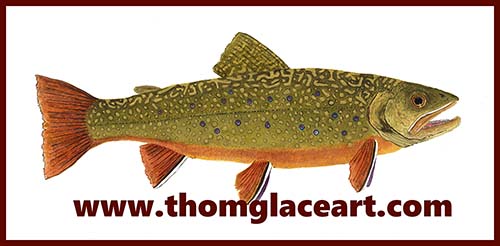


The zander, sander or pikeperch, is a species of ray-finned fish from the family Percidae, which also includes perch, ruffe, and darter. It is found in freshwater and brackish habitats in western Eurasia. It is a popular game fish and has been introduced to a variety of localities outside its native range. Scientific name: Sander lucioperca: IGFA world record 25 lb 4 oz, Switzerland 2016. Image by award-winning watercolorist Thom Glace.
Scandinavian anglers have embraced tube flies way beyond their Scottish initiators

Henry Clement, Rehoboth Beach, Delaware, August 2023.
By Henry Clement
In Scandinavia, anglers have adopted and enhanced tube flies using construction methods unique to the region’s fisheries. Their desire to improve performance in the field compared to traditional hook-tied flies has solidified this preference. One angler in a Zoom podcast I attended remarked, “Tube flies offer more movement, efficiency, and practicality than hook-tied flies. It should be obvious.”
In Scandinavia, anglers have adopted and enhanced tube flies using construction methods unique to the region’s fisheries. Their desire to improve performance in the field compared to traditional hook-tied flies has solidified this preference. One angler in a Zoom podcast I attended remarked, “Tube flies offer more movement, efficiency, and practicality than hook-tied flies. It should be obvious.”
Atlantic salmon initially sparked the global popularity of tube flies, but anglers primarily use them for Atlantic and Pacific salmon species
However, tube flies are particularly effective for steelhead, especially in the Northwest. This limitation disadvantages U.S. and Canadian anglers compared to fly fishers in Finland, Norway, Denmark, Sweden, and the Ponoi River region of northeastern Russia, who fully embrace the use of tube flies.
The shift to improve angling outcomes for various species has occurred rapidly in Scandinavian waters and includes fish such as:
- – Brown trout
- – Zander
- – Pike
- – Sea trout
- – Grayling
- Innovations in fly tying feature distinct compact proportions and tapered hair wings, often made from Arctic fox, raccoon, or dense rodent fur.
- Riffle Hitch Tube Flies are also quite popular.
Scandinavian fly tying strongly emphasizes movement and “breathing” in the water, mimicking the behavior of aquatic insects throughout their life stages, particularly during their transition to adulthood. This frantic transformation is critical for survival and represents the best feeding opportunity for riverine prey such as trout.

Fly fishing in Halistenkoski rapid in Turku, Finland, on 24 September 2011. Photo credit kallerna
Materials that replicate aquatic insect air bubbles as emergers include flashabou, Mylar, pearl tinsel, bead heads, CDC feathers, buoyant foam, and dense dubbing or synthetic hair
Scandinavian tube flies are designed specifically to create turbulence, utilizing hair wings tied in a zonker style or fashioned using traditional hair wing methods. Anglers in Scandinavia often adopt a tube fly system known as the Frödin Improved Tube System (FITS). This system incorporates flexible colored tubing available in various diameters paired with weighted cones, such as brass turbo cones and tungsten cones or tubes. This combination enhances the fly’s swimming action and improves weight distribution.
The design allows you to tie the tubes with either a loose or fixed hook, creating an open and lively profile that performs effectively in currents
Additionally, it is worth noting that Ruben Martin from Argentina is regarded as one of the most innovative tube fly designers in the world, a reputation he has maintained for decades. We highly recommend contacting Martin to elevate your tube fly experience. Click here to connect.
Watch these two videos:
Sponsored