

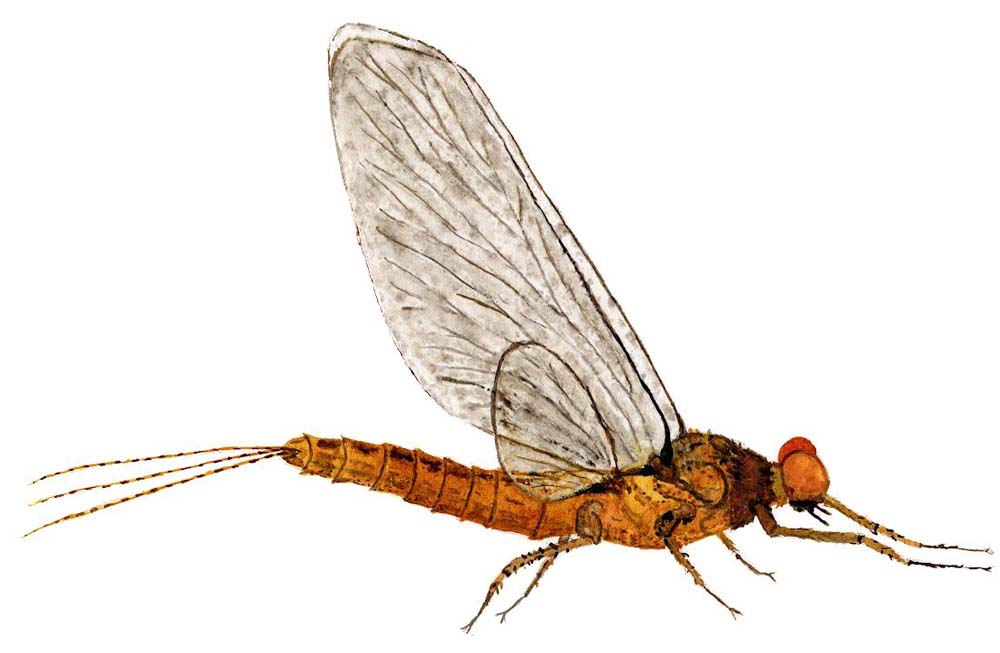
Male Hendrickson Dun – Thom Glace illustration.
Making the dry fly more than an indicator

Henry Clement, Rehoboth Beach, Delaware, August 2023.
By Henry Clement
It’s not an over-simplification acknowledging the aforementioned
The real improvement is how the dry is initially tied onto the leader, how the combo of dry and dropper is cast and drift-fished as slackless as possible. And how the line, leader, and fly are retrieved, picked up from the water. The latter may slip by your attention, but the pick-up is an essential ingredient in prolonging your undetected presence and in having you next cast-drift a genuine possibility of interest to mykiss, trutta, or fontinalis.
A poor pick-up, like a poor cast, will both exhibit “kerplops.” The flies slapping the water when cast, or a pick-up exhibiting the reverse kerplop by pulling fly, leader, and too much fly line while still completely under tension on the water.
Let me know introduce Dave Peachy
Active fly fishers often use a dry fly paired with a nymph dropper, essentially turning the dry into an indicator for the nymph below. While the occasional trout does rise for the dry, the real opportunity lies in making the dry fly an appealing target itself—not just a signal. By focusing on how the dry can attract fish while still functioning as an indicator, we can rethink its role and effectiveness.
Map of Snowy Mountains in Australia’s New South Wales
NOTE: Dave is a guide from Australia’s New South Wales Snowy River Mountains district, where dry-fly angling is a favorite way to catch trout.
Watch Dave Peachy’s videos
Dave Peachy has a better way to tie on a dry fly on a nymphing setup
Sponsored