

Russell Blessing is holding his Woolly Bugger. Photo by Fly Rod + Reel.
The Woolly Bugger

Henry Clement, Rehoboth Beach, Delaware, August 2023.
By Henry Clement
Russell Blessing, a Pennsylvania trout and smallmouth bass angler, invented the Woolly Bugger, which debuted in August 1967. Its first catch was a trout.
A revised plan works miracles
Blessing designed the fly to mimic the larval stage of the Dobson, known as hellgrammites, to attract smallmouth bass, his preferred target. When the fly turned out differently than he expected, he added a marabou tail, and his daughter, Julie, dubbed it the “Woolly Bug.”
Now it’s a bugger
On that fateful day in August 1967, Blessing was fishing the Little Lehigh River in Pennsylvania while Barry Beck fished downstream without any luck, just like everyone else. Armed with his new Woolly Bugger, Blessing was catching trout one after another. Barry decided to try a Woolly Bugger himself, hoping to start catching trout as well. The rest is history; arguably, the Woolly Bugger became the best fly ever invented to date.
I have been using the Woolly Bugger in various forms for steelhead and trout since 1968 in Pennsylvania.
Changing
In the early 1990s, I relocated to South Florida, where I stayed until July 2014. That year, I made my final move to the foothills of the Appalachian Mountains in Georgia. My travels have taken me fishing with the Bugger in Iceland, Argentina, New Zealand, Alaska, Canada, Belize, and other locations—but not to Antarctica.
I’ve used the Bugger for everything from trout and steelhead to tarpon and snook, and now back to trout, crappie, and notably, hybrid stripers in Georgia. The Bugger has been a companion throughout my 57-year fishing journey.
One significant change I made had a dramatic impact on my fishing
While in Florida, I introduced the Bugger to saltwater species and later freshwater largemouth bass. However, the Bugger tied with saltwater hooks became too heavy, making good casting challenging for me.
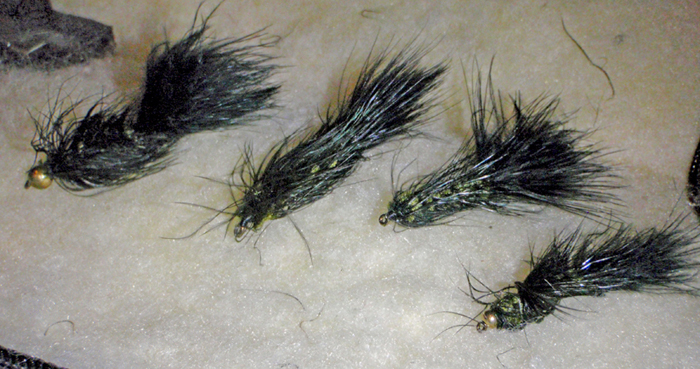
These were tied by Russell Blessing, inventor of the Woolly Bugger, and provided courtesy of Fred Blessing, his son.
One change is enlightening
I then transitioned from hook-tied flies to tube-tied flies, which made a considerable difference. Initially, it was about improving casting. Saltwater flies typically use heavier hooks than freshwater flies. A tube fly does not depend on the size of the hook. For instance, a large tube-tied tarpon fly does not require a heavy 4/0 or larger hook; it can be equipped later with a lighter carbon steel hook. Additionally, the hook for a tube-tied fly can be changed out at any time while fishing, making it better suited for various environments, including saltwater, brackish waters, and freshwater in South Florida.

I didn’t get lucky; I just followed Steve’s instructions to join him in sampling the salt marsh. Steve Kantner photo.
I also found it easier to tie on tube flies, starting with Q-tip cotton swabs and then moving to better pricking hooks
For tarpon anglers, a “prickier” #4 carbon steel hook, or one slightly larger or smaller, can be adjusted by turning the point either up or down, changing the orientation without needing to switch hooks. The result is a much lighter fly that is easier to cast. The option of using a tube fly allows anglers to cast a lighter fly further and more accurately. Effective casting is the most crucial skill in fly fishing, unless someone is misguided about its importance. Of course, casting improves with the right fly line, leader, and properly sized fly.
What’s in your future?
So, why not enhance your fishing experience? The transition to tube flies is inexpensive and makes tying simpler.
Sponsored