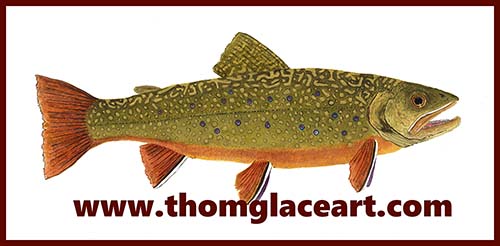


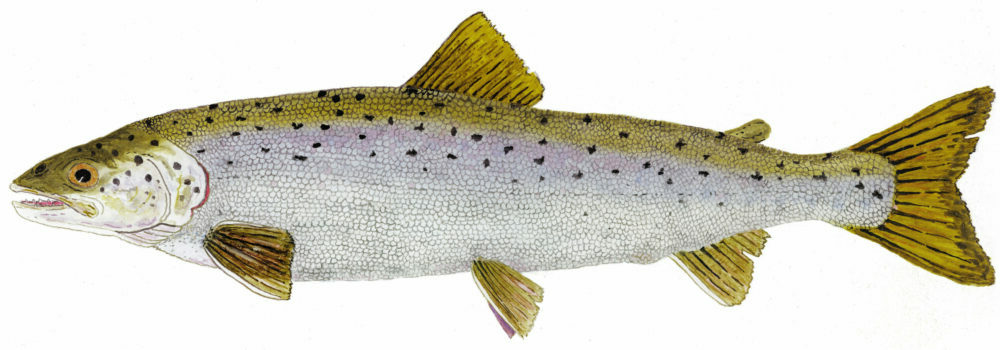
“Adult Atlantic Salmon” by Thom Glace, an award-winning watercolor artist, dedicated fly fisher, and conservationist. Atlantic salmon is often called the “King of Fish” due to its large size, resilience, leaping ability, and determined upstream migrations.
Can Wild Salmon Be Saved? Sea lice infestation is one of the costliest challenges facing the global salmon farming industry
By Henry Clement
Farmed salmon in Norway struggle against several parasites, including the notorious sea louse and the microscopic pathogen Spironucleus. In recent years, sea lice have developed resistance to many chemical treatments. The crowded conditions in aquaculture have exacerbated these outbreaks, jeopardizing wild salmon populations. Recent reports highlight the alarming situation for salmon farms: Factory farming threatens to decimate wild salmon populations in Norway as the spread of salmon lice spirals out of control. These parasites infest farmed salmon and also impact wild salmon migrating between the sea and Norway’s rivers, escaping from the open-net cages of offshore salmon farms, where millions of fish reside. Fishing enthusiasts, scientists, and environmentalists actively work to conserve wild salmon.

Disease often occurs after heavy lice infestations. In the global fish farming industry, there is a tendency to prioritize profit over environmental health, which is a common issue in agriculture. Although new technologies, specifically closed containment systems, have been developed, their adoption has been limited due to high initial costs. In the absence of mandatory regulations across all regions, these systems struggle to compete effectively in the global market.
In autumn, aquatic biologist Helge Skoglund dives into Norway’s frigid rivers to help the government track wild salmon numbers as they swim upstream to spawn
In Norway, experts express severe concern, fearing the population may plummet to a shocking new low, dropping from over one million to less than 400,000.
“I’m worried that there won’t be enough salmon to ensure the long-term stability of the population,” Skoglund said. Consequently, many rivers have been closed to fishing. With approximately 1,000 salmon facilities struggling to control the spread of salmon lice, the Norwegian Seafood Council reports an average fish mortality rate of around 17%.
However, a salmon farmer named Thomas Myrholt has taken a different approach. He has invented an ecological alternative: tanks that isolate farmed salmon from the open sea. Myrholt reports that his stocks are free of salmon lice, and he advocates for new regulations promoting sustainable farming practices.

Small but deadly: Spironucleus salmonicida.Photo: Alchetron
Spironucleus salmonicida
Since 2022, the microscopic parasite Spironucleus salmonicida has continued to plague salmon farming operations in Norway.
In British Columbia, a May 2025 study revealed high levels of sea lice on wild juvenile salmon in the Discovery Islands, even after salmon farms in the region closed.
This indicates that natural sources of sea lice play a significant role, but it doesn’t negate the impact of salmon farms on wild fish populations. Recent research published in 2024 revealed that Spironucleus salmonicida has cost Grieg Seafood, a major producer, $86 million since 2022 due to its effects on fish mortality and quality.
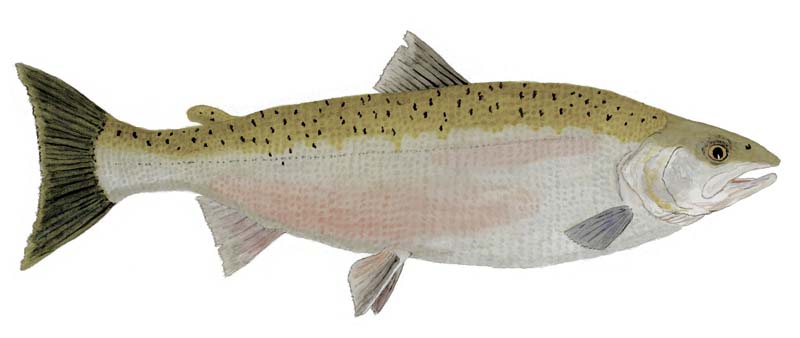
Pacific salmon return from the sea, Coho (Silver) Salmon (Oncorhynchus kisutch). The only true jumper of the Pacific salmon. Illustration by world-class colorist, Thom Glace.
Sea lice in the Pacific Ocean are developing resistance
In January 2025, the Norwegian Research Institute [NOFINA ]announced an effective ultraviolet (UV) light treatment to combat Spironucleus in hatcheries, offering hope to an industry grappling with this persistent parasite. Additionally, a 2022 study warned that sea lice in the Pacific Ocean had begun developing resistance to the common treatment emamectin benzoate (SLICE).
This growing resistance complicates efforts to control future outbreaks. The continuous presence of parasites remains a significant challenge for salmon farms globally. The high-density conditions of aquaculture foster parasite proliferation and outbreaks, leading to increased stress, injury, and disease in farmed fish, which in turn results in reduced growth, higher mortality rates, and economic setbacks for the industry.

Sea lice remain one of the biggest challenges facing salmon farming worldwide. This issue is worsening globally, and no improvement is on the horizon. The only known solution to this infestation is land-based aquaculture. However, money drives the industry.
Sources: Norwegian Seafood Council, Norwegian Research Institute, Helge Skoglund, Institute of Marine Research, Atlantic Salmon Federation, NOAA Fisheries, Alaska Department of Fish and Game
NORWAY ATLANTIC SALMON
Sponsored