
Ginger Rogers, an avid and accomplished fly fisher, was pictured on the cover of LIFE in 1942. She was an American actress, dancer, and singer during Hollywood’s “Golden Age” and remains an iconic figure in American film. Rogers won an Academy Award for Best Actress, but is best remembered for her celebrated 1930s musicals with Fred Astaire at RKO.

Fly reels are works of art, but they are also much more than that. Beyond their visual appeal, fly reels are precision-engineered tools that play a vital role in the angler’s experience. Their balance, durability, and performance can make all the difference between landing a prized catch and watching it slip away. The craftsmanship that goes into each reel is a testament to both functionality and beauty, making them true masterpieces in the world of fishing.

Henry Clement, Rehoboth Beach, Delaware, August 2023.

By Henry Clement

What you want and might not know you need in a big fish fly reel:

REPEATABILITY – consistent drag performance throughout every fish fight, whether it’s today or months later. Plus, a smooth drag that eliminates the STARTUP INERTIA.

Startup inertia failure occurs when the preset drag of X pounds temporarily exceeds its setting, sometimes surging to X+4 pounds, which can snap the tippet. You also want to eliminate PULSING—when the drag fluctuates above and below the intended setting—since this flawed behavior can also lead to tippet failure.

When you invest in a fly reel, you’ve likely considered many factors, especially performance specifications, data, and, of course, the warranty.
If you had a little flexibility in your wallet, your purchase could have easily been swayed by pure aesthetics, which at times becomes the sole deciding factor—especially if the item is brand-proofed. That kind of determination is familiar to many of us who hunt, as we’re often seduced by what I call the Bentley factor: favoring a particular shotgun or rifle simply because it “does not” look like a Volkswagen Beetle.

My pick out of the gate and no regrets, and still ticking. The X-Series is noted as the winner of the 2015 IFTD/AFFTA “Best of Show” award in both freshwater and saltwater reel categories, which marks its introduction year.

Over my 86 years, my choices in fly reels have taken me all over the map

Early on, the prevailing tech talk was sheer nonsense—things like “click and pawl,” come on, please. [Wonder Bread is Wonder Bread.] Still, I maintained a partiality for even modest design features, like those found in Pflueger’s Medalist and Orvis’ Battenkill, along with their understated aesthetics. Service expectations rounded out most of my purchases in the ’50s and ’60s. And as a personal note, my reels still need to understand they’ll spend most of their time with me largely ignored until I go fishing.
The first modern fly reels to capture that magic combination of sheer beauty and engineering advances, at least to my eye, emerged in New Hampshire in the mid-1950s. “Modern-day” is the keyword—there were certainly gorgeous reels made as early as the late 19th century, before Stanley Bogdan. Bogdan’s reels stood out for two distinctive engineering features: a signature double-brake shoe and a ten-position lever to regulate drag.
Bogdan Reels became so coveted—and the wait times so long after ordering—that they became part of a famous Bronx Jewish doctor joke punchline:

“. . . My doctor is so good that nobody has ever seen him.”

In this 1981 photograph from Outdoor Life Magazine, Stanley Bogdan stands surrounded by an impressive array of his meticulously crafted fly reels. Renowned for his precision and artistry, Bogdan’s workbench is a testament to a lifetime dedicated to the craft of reel making.

The Ted and Pate show
When saltwater species, especially tarpon, started pushing the limits of fishing reels, an immigrant from Hungary and the first prominent tarpon-on-fly angler joined forces with a handshake at George Hommell, Jr. and Billy Pate’s fly shop in Islamorada, Florida—World Wide Sportsman. That name endured, thanks to Johnny Morris of Bass Pro Shop/Cabela’s, who kept it after purchasing the shop from George Hommell and partners.
The result of that meeting was a tarpon reel designed and built by Ted “Tibor” Juracsik, which still bears its original name—the Billy Pate Tarpon Reel—and is available today in essentially the same form.

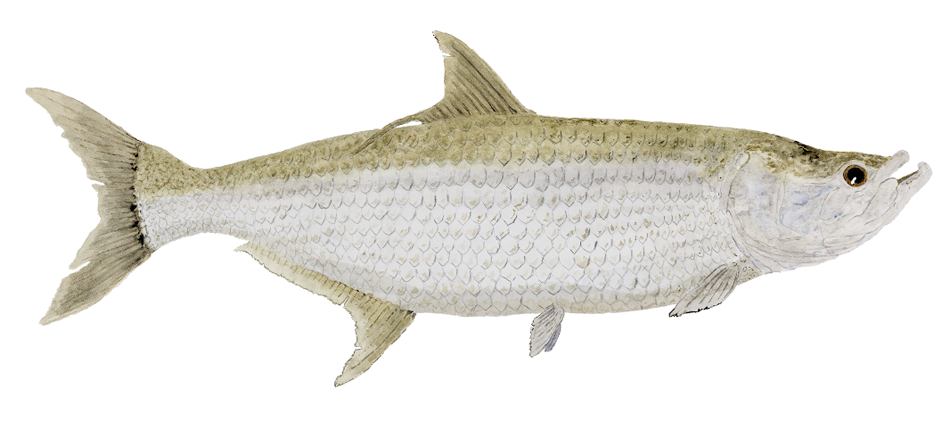
Tarpon [Megalops atlanticus] illustration by Thom Glace.

The Florida Keys proving grounds

This collaboration marked the beginning of big game fly fishing. Following the introduction of the Billy Pate reel, saltwater fly fishing exploded under the guidance of Florida Keys captains.
Soon, the Florida Keys and its guides became so closely associated with saltwater fly fishing that any product intended for use in saltwater needed to earn approval in the Florida Keys “Proving Grounds.”

Fast forward

Today, anglers have a multitude of fly reel options, many of which are manufactured in countries with widely varying minimum wages: 63 cents per hour in Indonesia (as of 1/1/2019), 98 cents in China (as of 7/31/2018), and $7.25 in the US (as of July 24, 2009).
While $0.63 an hour in Indonesia and $35+ per hour range in South Florida—or anywhere else in the US—represent the respective minimum wages at the time, these figures only tell part of the story. Expressed as a percentage difference for doing the same job, the gap is a staggering 193%. Add in government subsidies and manipulated currency systems, and it’s clear why Asian-made products are significantly less expensive.

Pictured with his world record tarpon caught on a fly with his custom Tibor-built Billy Pate Tarpon Reel. Image 1987 in Homosassa, Florida. The record stood for 21 years.

The fly reel industry

Meeting and maintaining specifications are essential in the modern fly reel industry, but these standards can sometimes be difficult to achieve with overseas brands. Shortcuts and reduced quality often occur when production is not directly managed or overseen by the purchasers, particularly with many Asian manufacturers.
Major corporations like Apple and others operate their own facilities in China and across the Far East, ensuring consistent quality and reliable warranties. However, for small companies, which represent much of the fly fishing industry and generate about a billion dollars annually in the US, maintaining quality can be challenging when sourcing directly from China, for example.

A friend once compared monitoring production in China without on-site oversight to leaving 14 freshly baked chocolate cookies labeled with your name in the break room, walking away, and expecting to find all 14 cookies still there when you return.

Lost in the woods

As a result, companies with sales under a few hundred thousand dollars often find it nearly impossible to control quality in an unmanaged manufacturing environment—especially when it comes to protecting patents, unique processes, and proprietary formulations. However, if a product or component is manufactured in China but purchased through reputable companies such as Pure Fishing, Far Bank, Orvis, 3-Tand, or Henry Fly Rod & Reel, you can be confident you are in good hands.

Kristen Mustad, owner of Nautilus Reels, has helped establish Nautilus—made in the USA—as a modern big-game go-to fly reel, rivaled by Mako Reel Co. A few other brands also lay claim to superior drag systems, reliable start-up inertia, and the ability to minimize tippet-snapping ‘pulsing’ when a fish runs.


Sponsored

Skip

Author Skip

More posts by Skip

Leave a Reply

Translate »